

'/%3e%3cpolygon%20points='228.5%20230%20228.5%20811.9%200%20811.9%200%20458.4%20228.5%20230'%20fill='rgb(53,%2053,%2049)'/%3e%3cpath%20d='M814.6,227.1C813.9,101.5,711.9,0,586.2,0H0v228.5h586.2v356.3l228.5-228.5v-129.2h0Z'%20fill='rgb(53,%2053,%2049)'/%3e%3cpath%20d='M308.4,1111.8c-25.2,4.5-51.7-.6-71.5-16.8-13.6-11.2-22.6-26.9-25.7-44.3-1.7-9.5-1.7-19-.3-28.6,4.8-31.7,28.7-55.4,59.8-62.2,13.2-2.9,26.6-2.9,39.8-.2,31.2,6.5,55.4,30.2,60.5,61.8,1.5,9.6,1.5,19.1,0,28.6-5.4,32.2-30.4,55.8-62.6,61.6ZM302.2,1085.3c18-3.6,30.7-16.8,35-34.3,2.4-10.1,2.4-20.5,0-30.6-1.8-8-5.5-15.1-11-21.1-11.4-12.7-29.2-16.9-45.8-13.6-18.1,3.6-31.3,16.8-35.5,34.8-2.3,10-2.3,20.3,0,30.3,2,8.7,6.2,16.5,12.5,22.8,11.6,11.5,28.7,14.9,44.7,11.8Z'%20fill='rgb(53,%2053,%2049)'/%3e%3cpath%20d='M89,1047.2l39.9,62.9h-36.5c0,0-36.4-61.5-36.4-61.5h-23.5s0,61.5,0,61.5H1.1s0-149.2,0-149.2h74.9c5.9,0,11.4.9,16.9,2.4,18,5.3,31,19.3,32.1,38.3.4,6.6-.3,12.8-2.5,19-5.7,14.9-18.3,23.2-33.5,26.6ZM91.8,1000.8c-1.2-6.2-5.6-10.8-11.5-12.8-3.2-1-6.3-1.4-9.7-1.5h-38.1s0,38.6,0,38.6h39.7c3.6-.3,6.8-.8,9.9-2.2,8.8-3.9,11.4-12.9,9.6-22.1Z'%20fill='rgb(53,%2053,%2049)'/%3e%3cpath%20d='M771,1075.3h-65.1s-12.7,34.9-12.7,34.9h-33s59.2-149.2,59.2-149.2h39.6s59.8,149.2,59.8,149.2h-35s-12.6-34.9-12.6-34.9ZM762.5,1050.9l-24.4-63.8-23.7,63.8h48Z'%20fill='rgb(53,%2053,%2049)'/%3e%3cpolygon%20points='528.8%201032.8%20594.1%201110.2%20553.5%201110.2%20496.4%201041.2%20496.4%201110.2%20464.7%201110.2%20464.7%20961%20496.4%20961%20496.5%201028.6%20549.4%20960.9%20586.5%20961%20528.8%201032.8'%20fill='rgb(53,%2053,%2049)'/%3e%3c/svg%3e)
Where ROKA sits
Our Salt and pepper is diamond-ground to 800 grit, where polishing begins. Cream comes straight from the mould. Both are sealed.
We cast worktops, islands, hearths and tables, and make sinks to order, but we don't polish floors.
By Aaron, founder of ROKA Studio. Updated 15 October 2026.
At a glance
Concrete ground with diamonds, or any smooth decorative concrete. Ask which one you are being sold.
Cream, straight from the mould, and Salt and pepper, ground to 800 grit. Both are sealed with SureCrete XS-327.
High polish and terrazzo. We talk each one through with you first.
Supply only, up to 30mm thick, the same in either finish. What a worktop costs
Is all polished concrete actually polished?
No. The words get stretched. Strictly, the surface is refined step by step with bonded diamond tooling. Metal-bond diamonds grind it up to about 100 grit, resin or hybrid pads hone it from 100 to 400, and polishing starts at 800 grit and can finish as fine as 3,000. A liquid silicate called a densifier usually goes on part way, to harden the surface.
The Concrete Polishing Council puts it simply. If the shine comes from a coating, you are looking at coated concrete, not polished concrete. How the Council grades classes and levels
Loosely, people use the words for trowelled and burnished floors, for grind-and-seal, for a cast face that is only sealed, and even for laminate. None of that is wrong to search for, but it means you need to ask what the surface actually is.
Cream is the cast face, sealed and not ground, while Salt and pepper is ground through 800 grit and then sealed.
Diamond tooling, grit by grit. The shine comes from the concrete.
Any decorative concrete. The shine may come from a trowel, a mould or a coating.
What are the levels of polished concrete?
Two separate dials get tangled together. One is how much the surface reflects, the other is how deep the cut goes, and the grit figures below are a guide.
| Level | Name | Grit guide | What you see |
|---|---|---|---|
| Level 1 | Flat | Ground below 100 grit | A flat, matte face with no reflection. |
| Level 2 | Satin, or honed | 100 to 400 grit | Smooth, with a low sheen and soft reflections. |
| Level 3 | Polished | 800 grit and up | A clear shine that reflects a recognisable image. |
| Level 4 | Highly polished | Up to about 3,000 grit, or burnished | A mirror shine. |
| Class | Name | What shows | Our nearest finish |
|---|---|---|---|
| Class A | Cream | Almost no sand shows. It is mostly cement paste. | Cream looks like this, but is not ground. |
| Class B | Salt and pepper | The fine sand shows. | Salt and pepper. |
| Class C | Exposed aggregate | The coarse stones show. | Not one of our standard finishes. |
Older charts had four classes with cut depths, and the 2024 chart dropped the depths. The Council now grades sheen by how clearly a surface reflects an image, measured on bare concrete before any sealer.
These charts were written for floors. There is no UK standard and no worktop standard, so makers borrow them.
Where do ROKA's finishes sit on that scale?
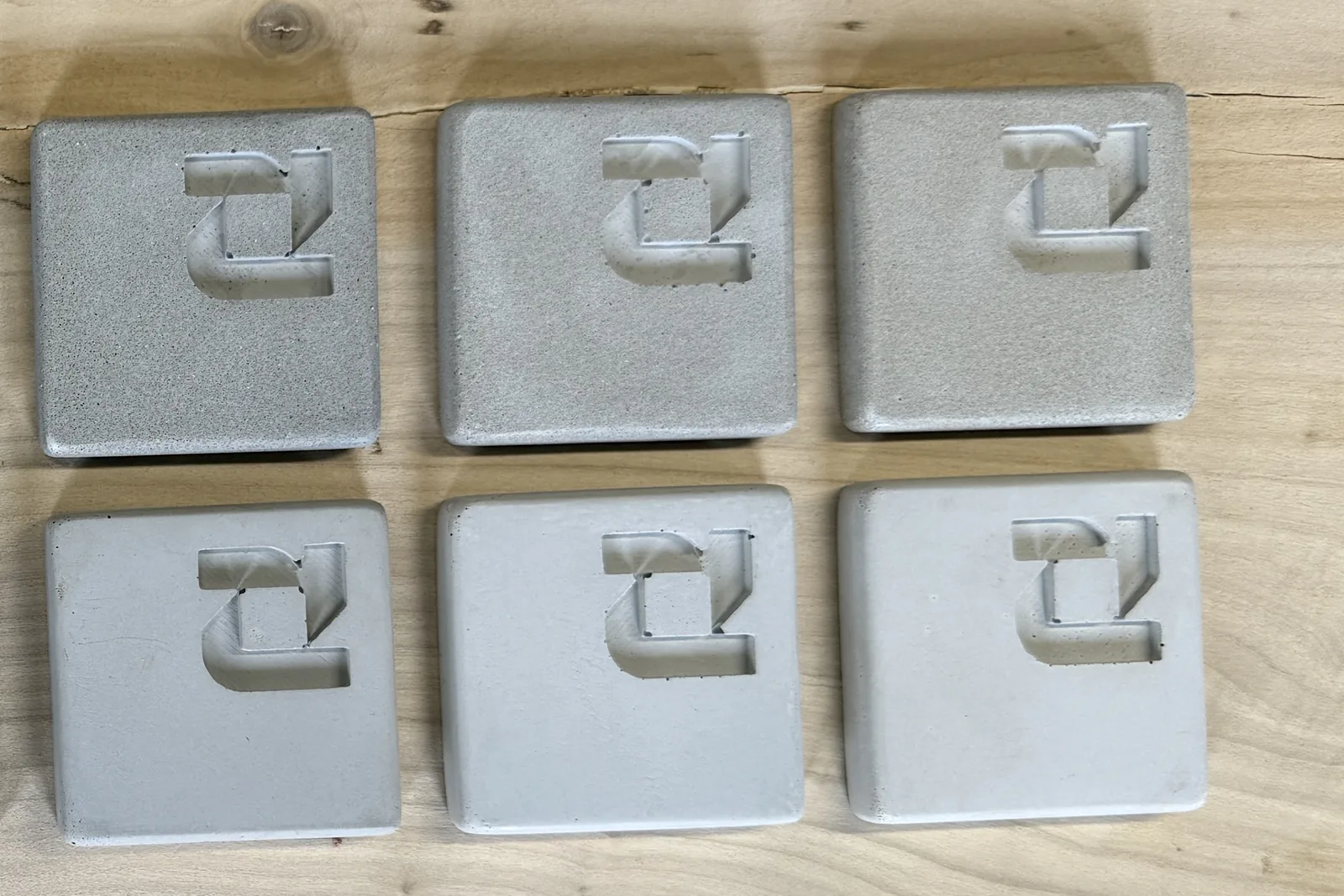
Cream
Cast face down into a smooth mould, the cement paste settles into a thin, dense skin that carries the colour at full strength. It looks like Class A but is not ground, so the sheen comes from the mould face and the seal. Nothing is ground away.
Salt and pepper
Diamond pads take the skin off, coarse to fine, to 800 grit, and the fine sand shows, which is what the trade calls Class B. A scratch has no skin to cut through, so it blends in, and the final sheen is set by the seal.
High polish and terrazzo
These are special orders, so we talk each one through with you first. Ask us and we'll send a sample. Choose between our two standard finishes
Why does the seal decide the sheen on a worktop?
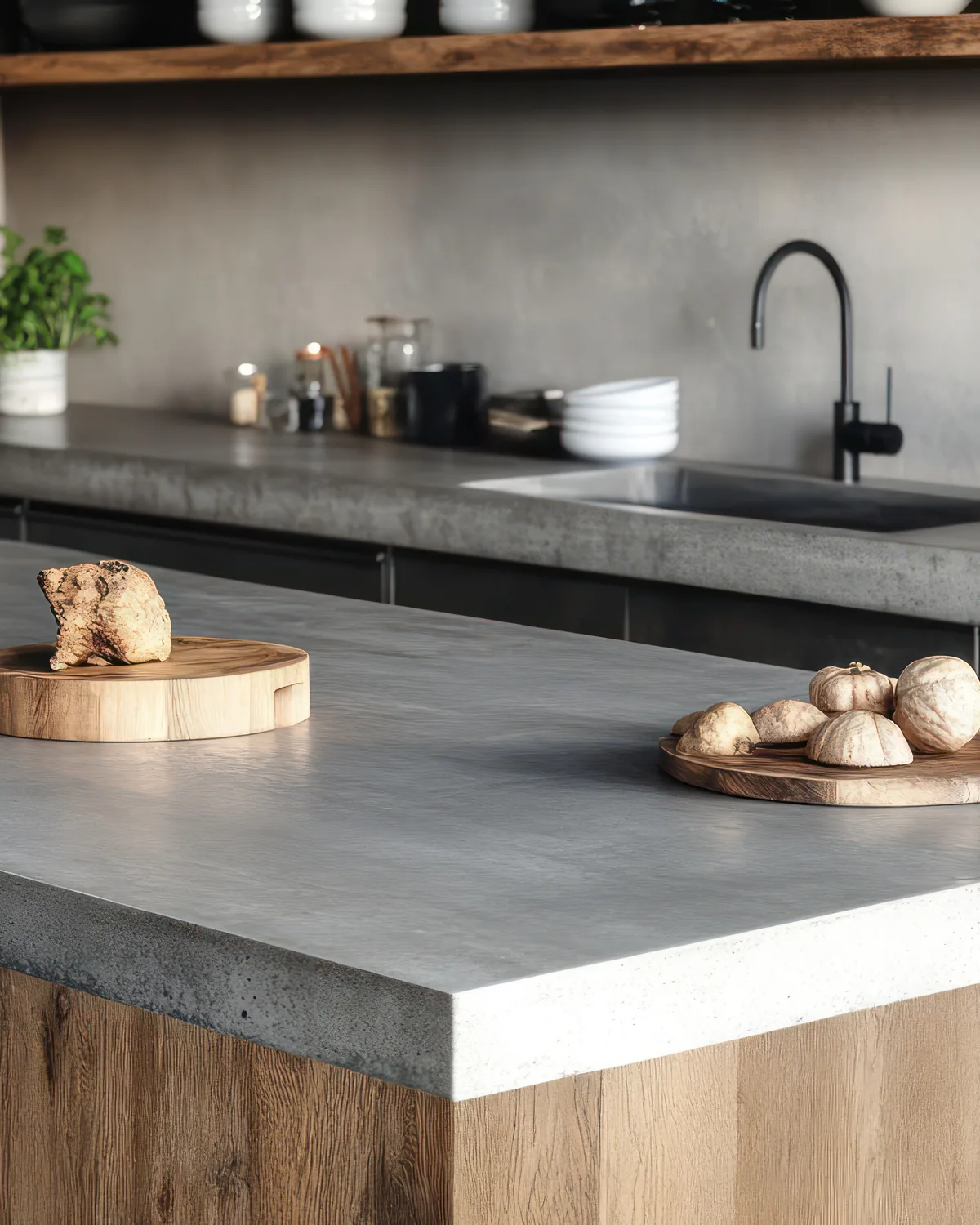
On a floor, the polish is the finish. On a kitchen worktop, the seal is the finish you touch, because every concrete worktop needs one and it sets how the top looks and feels.
In general, penetrating sealers barely change the look and hold off acids for only minutes, while film-forming sealers protect more and add sheen. Some countertop makers find that grinding much finer than 400 grit adds little once you seal the top.
We stop at 800 grit and seal every piece with SureCrete XS-327, a two-part, water-based hybrid polyurethane. As standard we use the matte version, so you get a soft sheen, not a glossy one.
| Heat | Rated to 149°C. Use a trivet. |
|---|---|
| Light use | 24 hours after the final coat. |
| Full use, food safe | Seven days after the final coat. |
| Standard sheen | Matte. |
Is it real concrete?
Several things are sold as polished concrete, or mistaken for it. Here is what each one is.
Microcement
A coating 2 to 3mm thick, trowelled over another surface and sealed, so you get a thin skin and not a slab.
Terrazzo
Marble or stone chips set in a cement or resin binder, then ground and polished to a smooth face.
Polished plaster
Lime and marble dust trowelled onto a wall and burnished, usually for walls and not for worktops.
Laminate
A printed decor on a board, sold as polished concrete.
Concrete-look quartz
Engineered quartz with a concrete pattern printed through it.
Concrete-effect porcelain
Printed tiles, so you will see joints wherever they meet.
A ROKA piece is cast concrete, GFRC or UHPC, from mixes formulated in-house.
Questions people ask
Does polished concrete stain?
It can, if spills sit, because polishing and densifying make concrete less porous but do not make it stain-proof.
Acids such as lemon and vinegar dissolve cement paste and can dull it, which is called etching, and wine, tea and oil can mark or darken it. Wipe them off straight away with warm water and a soft cloth.
The seal is your protection. SureCrete XS-327 resists most household chemicals and food, and water beads on it. The seal is rated to 149°C. Use a trivet for hot pans. A worn patch can be lightly sanded and recoated in place. Caring for a concrete worktop
What's the difference between honed and polished concrete?
Grit. Honed is the satin level, worked with diamond pads from 100 to 400 grit, so it is smooth with a low sheen. Polished starts at 800 grit and runs to about 3,000 for a mirror shine. Countertop makers sometimes draw the line lower. Our Salt and pepper is taken to 800 grit, then sealed.
What is salt and pepper concrete?
It is a finish where the top skin of cement paste is ground off to show the fine sand in the mix, like a speckle of salt and pepper. The polishing trade's chart lists it as Class B. It is one of our two standard finishes, diamond-ground to 800 grit and then sealed. Compare it with Cream
What is cream polished concrete?
The words mean two things. In the polishing trade, cream is Class A, a light grind that leaves the cement paste on top and shows almost no sand. In UK magazines it usually means a floor smoothed with power trowels while wet, then burnished and sealed. Our Cream is a third route. It is the face of the mould, sealed.
Does polished concrete need sealing?
On a kitchen surface, yes, because every concrete worktop needs a seal against food and drink. Floors are often densified and left with only a thin guard. Every ROKA piece is sealed with SureCrete XS-327, which takes full use seven days after the final coat. Caring for a concrete worktop
Can polished concrete be repolished?
Yes, though how depends on what it is. A polished floor can be ground and polished again many times because the concrete is the finish, but on a sealed worktop the seal takes the wear, so a worn patch is lightly sanded and recoated in place rather than ground back. Ask us if a piece of ours needs it.
Do you polish concrete floors?
No. We cast worktops, islands, hearths and tables, and make sinks to order. If you want a floor, look for a polishing contractor and ask which class and level they will deliver, and whether the shine comes from the concrete or from a coating.
Can I see the finishes before I choose?
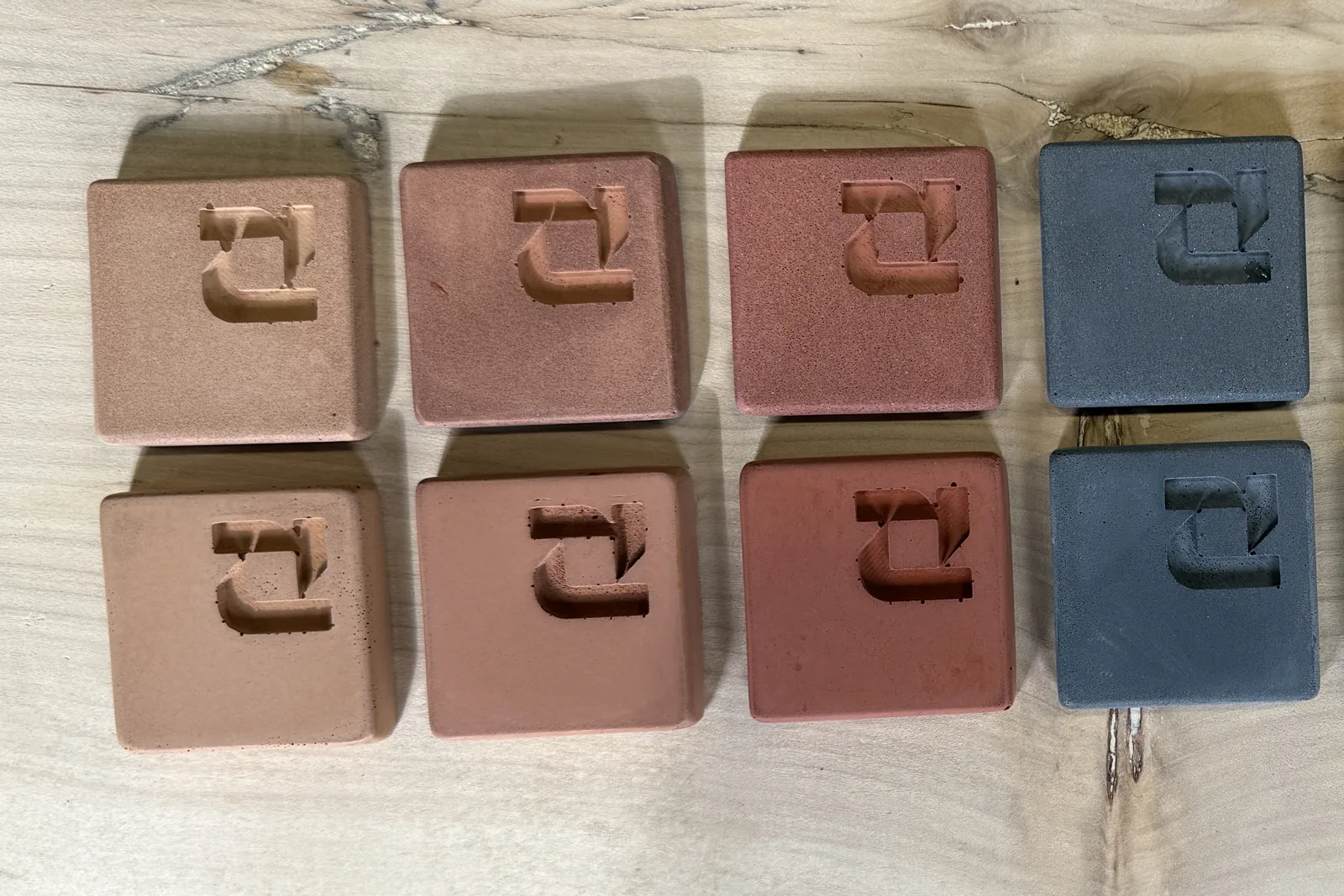
Yes. Sample tablets are free, cast and sealed exactly as a worktop, so what you hold is what you get. You can ask for up to five a request, and a colour in both finishes counts as two, which is the best way to see Cream and Salt and pepper side by side. Get my free samples
Glossary
- Grit
- The coarseness of a diamond pad. A low number cuts deep. A high number polishes.
- Hone
- To work the surface with diamond pads from about 100 to 400 grit, for a smooth, low sheen.
- Densifier
- A liquid silicate that soaks in and hardens the surface of a polished floor.
- Guard
- A thin protective coat, often used on floors instead of a full seal.
- DOI
- Distinctness of image. How clearly a surface reflects what is in front of it.
- Cream
- In the trade, a light grind that shows almost no sand. In UK magazines, a trowelled floor. For us, the sealed face of the mould.
- Salt and pepper
- A ground surface where the fine sand shows against the paste. Class B.
- Exposed aggregate
- A deep grind that shows the stones in the mix. Class C.
- Etch
- A dull mark where an acid has dissolved the cement paste.
- GFRC
- Glass fibre reinforced concrete, one of the two mixes we cast in. UHPC is the other.
What can be made in polished concrete?
Each card links to the page that owns it.
Polished concrete worktops
Cast to fit your kitchen, in Cream or Salt and pepper and any named colour.
Polished concrete kitchen islands
Cast to your drawings, in Cream or Salt and pepper.
Polished concrete sinks and basins
Made to order, and we talk each one through with you first.
Polished concrete hearths
Cast hearths for wood burners and stoves, made to fit your fireplace.
Polished concrete fireplace surrounds
Cast surrounds for your fireplace, made to order.
Polished concrete dining table tops
Made to size, with the price shown in the shop as you choose it.
Polished concrete cladding
Cladding tiles for indoor walls, with sizes and details on the page.
Polished concrete window sills and shelves
Sizes and prices are in the shop, ready for you to order.
See Cream and Salt and pepper in your own light.
Ask for Cream, Salt and pepper or both. The tablets are free, 50 x 50 x 10mm and sealed exactly as a worktop, so you can hold the finish before you choose. A colour in both finishes counts as two of the five you can ask for.
Delivered in person around Brighton and Sussex, or posted anywhere in the UK. Every worktop is backed by our 5-year guarantee. Worktops and islands typically take 3 to 6 weeks from design sign-off. Do concrete worktops crack?