

'/%3e%3cpolygon%20points='228.5%20230%20228.5%20811.9%200%20811.9%200%20458.4%20228.5%20230'%20fill='rgb(53,%2053,%2049)'/%3e%3cpath%20d='M814.6,227.1C813.9,101.5,711.9,0,586.2,0H0v228.5h586.2v356.3l228.5-228.5v-129.2h0Z'%20fill='rgb(53,%2053,%2049)'/%3e%3cpath%20d='M308.4,1111.8c-25.2,4.5-51.7-.6-71.5-16.8-13.6-11.2-22.6-26.9-25.7-44.3-1.7-9.5-1.7-19-.3-28.6,4.8-31.7,28.7-55.4,59.8-62.2,13.2-2.9,26.6-2.9,39.8-.2,31.2,6.5,55.4,30.2,60.5,61.8,1.5,9.6,1.5,19.1,0,28.6-5.4,32.2-30.4,55.8-62.6,61.6ZM302.2,1085.3c18-3.6,30.7-16.8,35-34.3,2.4-10.1,2.4-20.5,0-30.6-1.8-8-5.5-15.1-11-21.1-11.4-12.7-29.2-16.9-45.8-13.6-18.1,3.6-31.3,16.8-35.5,34.8-2.3,10-2.3,20.3,0,30.3,2,8.7,6.2,16.5,12.5,22.8,11.6,11.5,28.7,14.9,44.7,11.8Z'%20fill='rgb(53,%2053,%2049)'/%3e%3cpath%20d='M89,1047.2l39.9,62.9h-36.5c0,0-36.4-61.5-36.4-61.5h-23.5s0,61.5,0,61.5H1.1s0-149.2,0-149.2h74.9c5.9,0,11.4.9,16.9,2.4,18,5.3,31,19.3,32.1,38.3.4,6.6-.3,12.8-2.5,19-5.7,14.9-18.3,23.2-33.5,26.6ZM91.8,1000.8c-1.2-6.2-5.6-10.8-11.5-12.8-3.2-1-6.3-1.4-9.7-1.5h-38.1s0,38.6,0,38.6h39.7c3.6-.3,6.8-.8,9.9-2.2,8.8-3.9,11.4-12.9,9.6-22.1Z'%20fill='rgb(53,%2053,%2049)'/%3e%3cpath%20d='M771,1075.3h-65.1s-12.7,34.9-12.7,34.9h-33s59.2-149.2,59.2-149.2h39.6s59.8,149.2,59.8,149.2h-35s-12.6-34.9-12.6-34.9ZM762.5,1050.9l-24.4-63.8-23.7,63.8h48Z'%20fill='rgb(53,%2053,%2049)'/%3e%3cpolygon%20points='528.8%201032.8%20594.1%201110.2%20553.5%201110.2%20496.4%201041.2%20496.4%201110.2%20464.7%201110.2%20464.7%20961%20496.4%20961%20496.5%201028.6%20549.4%20960.9%20586.5%20961%20528.8%201032.8'%20fill='rgb(53,%2053,%2049)'/%3e%3c/svg%3e)
Concrete worktops,
made and installed
ROKA Studio designs, casts, finishes and installs bespoke concrete worktops from our workshop in Small Dole, West Sussex. Worktops are cast flat in the workshop, or in place on site where a run needs to turn a corner without a joint. We use GFRC and UHPC mixes formulated here, cast at full thickness or thin with returned edges where weight matters, in around thirty colours plus custom matching. Lead time is typically 3–6 weeks from design confirmation.
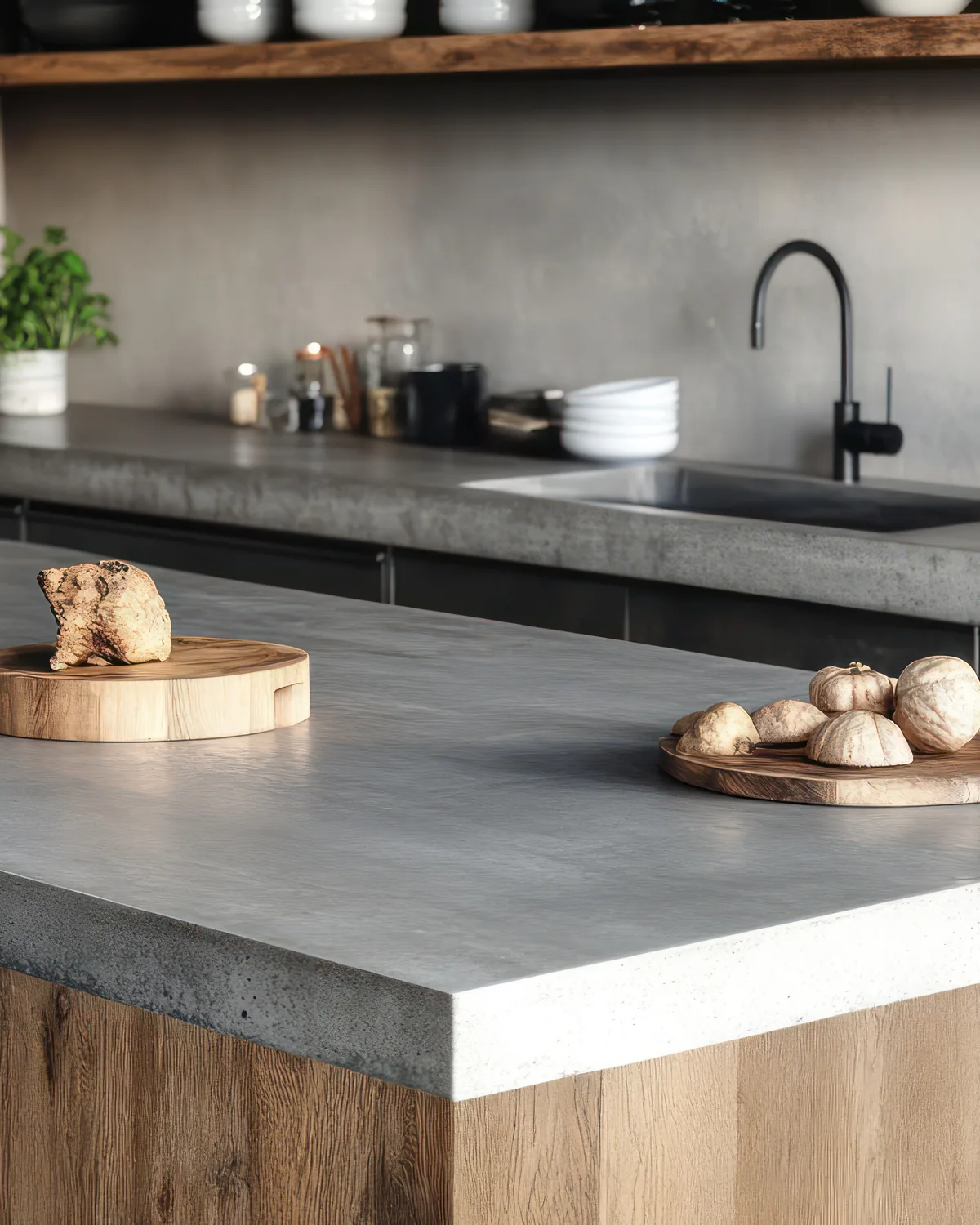
What we make
- Kitchen worktops
- Waterfall islands and breakfast bars
- Cantilevered overhangs
- Splashbacks and upstands
- Integrated drainer grooves
- Bar tops and servery counters
- Utility and boot room surfaces
- Vanity tops
Islands are their own engineering problem — spans, overhangs, support and getting a large piece into a finished room. More on concrete islands.
Two ways to make
a worktop
Workshop cast
Most concrete worktops are cast flat in the workshop, cured, finished and carried in. It is predictable, efficient and, for most kitchens, the right answer.
Cast in place
For cast-in-place work we build the formwork around your actual cabinetry and pour the surface where it will live. That is how you get a joint-free run across a long stretch, around a corner, or down a waterfall end.
It means more days on site and a higher price, and it is not right for every kitchen. We do both, and we will tell you honestly which one your project needs.
Peace of mind is priceless.
Concrete has a reputation, and most of it was earned by badly built driveways that crack. Glass-fibre reinforced concrete is a different material altogether, and failure is rare. But rare isn't never, and you shouldn't have to take our word for it, so everything we make comes with a five-year guarantee.
Read the guarantee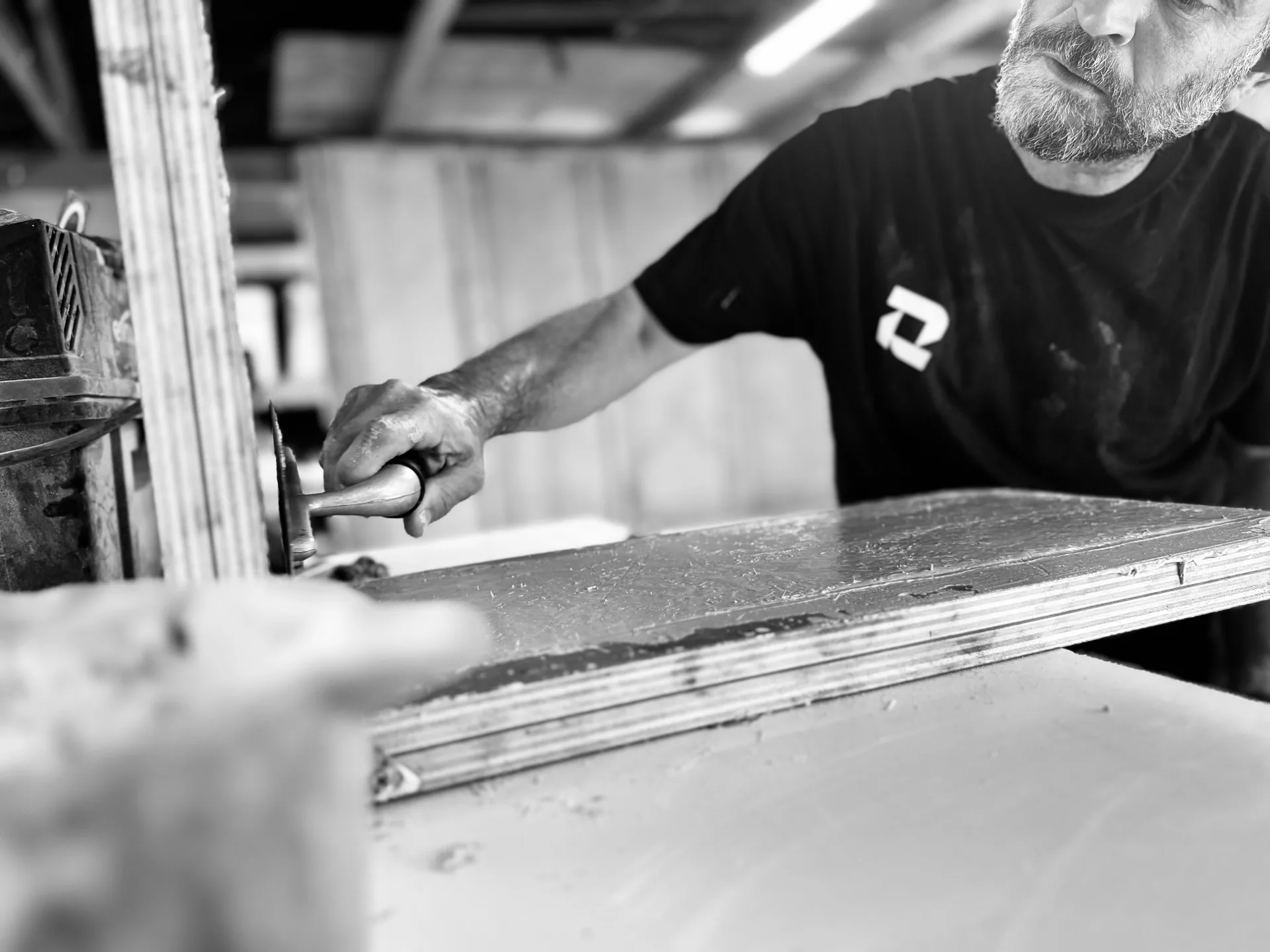
GFRC and UHPC,
mixed here
We formulate our own mixes rather than buying premix. UHPC gives high compressive and flexural strength with low porosity and a fine surface. GFRC takes its strength from alkali-resistant glass fibre distributed through the section rather than from steel bar, which is what allows much thinner pieces.
Most worktops are cast at their full finished thickness. Where weight matters, GFRC lets us cast thin with a returned edge, from a 12.5mm minimum. Cabinet loading, spans and support are still assessed on every project.
Are concrete worktops heavy?
No heavier than stone.
At the same thickness, concrete weighs about what granite, marble or quartz does. A 30mm granite top is around 80kg per square metre. Quartz at 30mm is around 72kg. Concrete at 30mm is around 70kg. Most of our worktops are cast at their full finished thickness, and the cabinets that would carry a stone top carry ours.
The heavy reputation comes from the old way of doing it: a slab poured thick, with steel in it, on braced cabinets. That is not how we cast.
Where lighter matters, GFRC gives us something stone cannot. It takes its strength from alkali-resistant glass fibre in the mix, not from mass, so we can cast thin and return the edges. Our latest island is a waterfall in 20mm GFRC with a 60mm apron along the front and 80mm at the back. From the room it reads as a solid block. On the cabinets it weighs a fraction of one. At our 12.5mm minimum, used for cladding tiles and special pieces, GFRC comes in at about 27.5kg per square metre, about the same as the laminate in most kitchens.
| Worktop | Thickness | Weight per square metre |
|---|---|---|
| Granite | 30mm | about 80kg |
| Quartz | 30mm | about 72kg |
| Concrete, cast at full thickness | 30mm | about 70kg |
| ROKA GFRC, cast thin with returned edges | 12.5mm | about 27.5kg |
| Laminate on chipboard | 38mm | about 26kg |
Figures are typical, worked from published material densities; the ROKA figure is weighed. Ask us for the weight of your actual design.
So do you need reinforced cabinets?
Usually not. If your cabinets would carry a stone top, they carry ours, and where we cast thin they carry less than laminate.
Long overhangs and cantilevers are the exception. We size the support for those at the design stage and tell you what is needed before anything is cast. More on that on the do concrete worktops crack page, and on kitchen islands for waterfall ends and breakfast bars.
Finish and colour
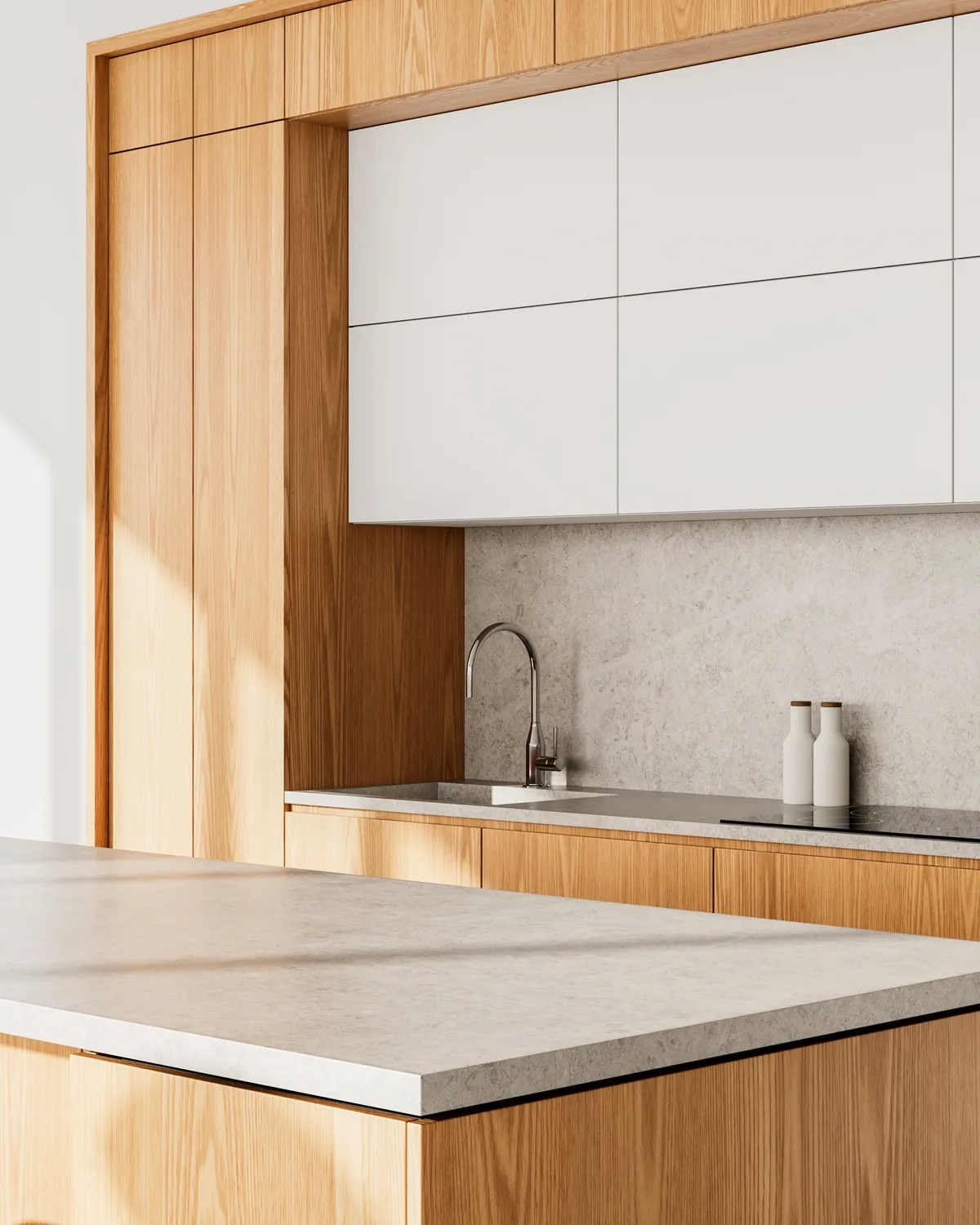
Two standard finishes: cream, straight from the mould, or salt and pepper, honed to 800 grit. Polished and terrazzo as special orders. See the finishes. Around thirty stock colours, plus custom matching to a sample, a paint reference or a fabric.
Colour on a screen tells you almost nothing. Order free samples and we will post cast tablets in the real colours and finishes — or bring them to you if you are nearby.
The questions people actually ask
What does it cost?
It depends on size, thickness, finish, cut-outs and whether we cast on site or in the workshop. Send a rough layout and we will give you a figure tailored to your project. See what drives the price.
Do concrete worktops crack?
Properly made ones should not. Cracking comes from shrinkage, reinforcement, support or load decisions, not from something that has to be accepted as part of concrete's character. Where a piece we made cracks, we treat it as a failure to be recast. Every piece we fit carries our 5-year guarantee: remade in the first year if it's our fault, repaired from year two to year five.
Read our full answer on crackingIs it too heavy for my cabinets?
Usually not. The assumption that concrete worktops need reinforced cabinets comes from thick, steel-reinforced slabs. At the same thickness, concrete weighs about what granite or quartz does, and where weight matters GFRC lets us cast thin with a returned edge. See the weights below. We assess loading and support on every job rather than assuming.
Does it need constant sealing?
No. Every worktop is sealed with SureCrete XS-327, a two-part water-based polyurethane. It is UV stable, low-VOC, food safe once fully cured and heat resistant to 149°C.
It can also be repaired in place. A damaged area is touched up rather than the whole surface being replaced — which is precisely what you will be told is impossible with concrete.
How to look after a concrete worktopHow long does it take?
Typically 3–6 weeks from the point the design is confirmed. Rush work can often be accommodated — ask.
See it before you commit
Concrete is a material you have to handle. We cast sample tablets in our stock colours and finishes and post them free, anywhere in the UK.
If you are nearby we would rather bring them to you and see the space at the same time. A colour behaves differently in the room it is going into than it ever does on a screen.
Order free samplesWorking with designers and builders
We work directly with kitchen designers, architects and main contractors. We will work from your drawings, template on site, and give you straight answers on weight, spans, cabinet loading, cut-out tolerances and programme dates before anything is committed.
Working with ROKA as a designer or builder
Talk to us about a specificationWhere we work
Our workshop is in Small Dole, West Sussex, ten miles from Brighton. We work across Sussex and Surrey as standard, with larger commissions taken in London. See the full service area.
Wondering what holds a thin worktop together? Read What's Inside a ROKA Worktop, If Not Steel? in the Journal.
Tell us about the space
Send a rough plan, a photo, or just the dimensions on the back of an envelope. We will tell you what is possible and what it is likely to cost.