'/%3e%3cpolygon%20points='228.5%20230%20228.5%20811.9%200%20811.9%200%20458.4%20228.5%20230'%20fill='rgb(53,%2053,%2049)'/%3e%3cpath%20d='M814.6,227.1C813.9,101.5,711.9,0,586.2,0H0v228.5h586.2v356.3l228.5-228.5v-129.2h0Z'%20fill='rgb(53,%2053,%2049)'/%3e%3cpath%20d='M308.4,1111.8c-25.2,4.5-51.7-.6-71.5-16.8-13.6-11.2-22.6-26.9-25.7-44.3-1.7-9.5-1.7-19-.3-28.6,4.8-31.7,28.7-55.4,59.8-62.2,13.2-2.9,26.6-2.9,39.8-.2,31.2,6.5,55.4,30.2,60.5,61.8,1.5,9.6,1.5,19.1,0,28.6-5.4,32.2-30.4,55.8-62.6,61.6ZM302.2,1085.3c18-3.6,30.7-16.8,35-34.3,2.4-10.1,2.4-20.5,0-30.6-1.8-8-5.5-15.1-11-21.1-11.4-12.7-29.2-16.9-45.8-13.6-18.1,3.6-31.3,16.8-35.5,34.8-2.3,10-2.3,20.3,0,30.3,2,8.7,6.2,16.5,12.5,22.8,11.6,11.5,28.7,14.9,44.7,11.8Z'%20fill='rgb(53,%2053,%2049)'/%3e%3cpath%20d='M89,1047.2l39.9,62.9h-36.5c0,0-36.4-61.5-36.4-61.5h-23.5s0,61.5,0,61.5H1.1s0-149.2,0-149.2h74.9c5.9,0,11.4.9,16.9,2.4,18,5.3,31,19.3,32.1,38.3.4,6.6-.3,12.8-2.5,19-5.7,14.9-18.3,23.2-33.5,26.6ZM91.8,1000.8c-1.2-6.2-5.6-10.8-11.5-12.8-3.2-1-6.3-1.4-9.7-1.5h-38.1s0,38.6,0,38.6h39.7c3.6-.3,6.8-.8,9.9-2.2,8.8-3.9,11.4-12.9,9.6-22.1Z'%20fill='rgb(53,%2053,%2049)'/%3e%3cpath%20d='M771,1075.3h-65.1s-12.7,34.9-12.7,34.9h-33s59.2-149.2,59.2-149.2h39.6s59.8,149.2,59.8,149.2h-35s-12.6-34.9-12.6-34.9ZM762.5,1050.9l-24.4-63.8-23.7,63.8h48Z'%20fill='rgb(53,%2053,%2049)'/%3e%3cpolygon%20points='528.8%201032.8%20594.1%201110.2%20553.5%201110.2%20496.4%201041.2%20496.4%201110.2%20464.7%201110.2%20464.7%20961%20496.4%20961%20496.5%201028.6%20549.4%20960.9%20586.5%20961%20528.8%201032.8'%20fill='rgb(53,%2053,%2049)'/%3e%3c/svg%3e)


By ROKA Studio
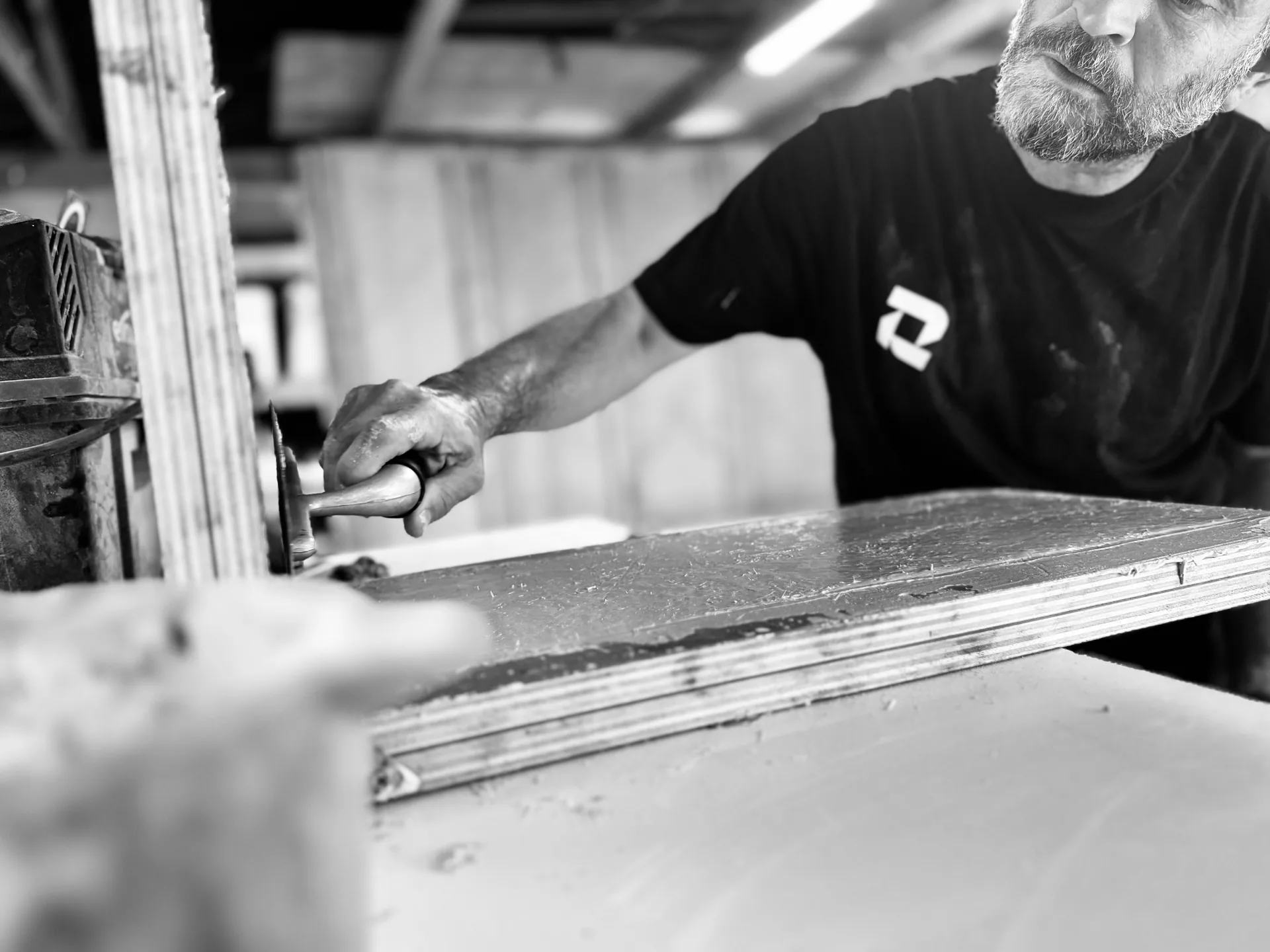
A ROKA worktop is cast thin, and thin concrete can't hold itself together on its own. Ours carries no steel. It carries glass.
Why does a thin piece of concrete need reinforcement at all?
Plain concrete is strong squeezed and weak bent. A worktop gets leaned on, knocked, picked up at the overhang during a fit. Something inside the mix has to take that load, or the first careless moment in the kitchen finds the weak point.
Why glass fibre instead of the steel you'd expect?
Steel does the job in a road or a foundation, but it needs mass around it. Rebar has to sit deep enough inside the concrete that it never reaches the surface, or it rusts, and the rust cracks the concrete from the inside out. That buried cover is exactly the thickness we're trying to avoid.
Glass fibre works differently. We mix short strands of alkali-resistant glass straight into the batch, so the reinforcement is everywhere in the piece at once, not sitting on one plane inside it. Nothing to bury. Nothing to rust. Nothing forcing a minimum thickness.
Does every part of a piece get fibre?
No. Face coats and sample tablets are poured without it, because they're not carrying a structural load. The fibre goes into the backing, and into anything that has to stand up to daily use in a kitchen. It's dosed into the batch it belongs in, not spread across the whole job.
Does it change how the worktop looks or feels?
No. It's mixed in before the pour, not applied after, so a finished, polished surface shows no trace of it. What it changes is what the piece can get away with: thinner edges, a longer unsupported overhang, a waterfall corner that's structural rather than decorative.
Is this the same as the concrete on a driveway or a patio?
Not really. That's a thick slab, poured in place, sometimes reinforced with steel mesh, and it's allowed to crack a little, patios always do. A ROKA worktop is closer kin to precast architectural panels: fibre-reinforced, cast in a mould, finished before it ever leaves the workshop.
Every sample tablet we send out shares the same core mix and colour as the concrete worktops it represents — the same face you'll live with. The one difference: a worktop's backing carries glass fibre for strength; a tablet, poured purely as a colour record, doesn't need it. What lands on your counter to test is the real finish, not a mock-up of it.
See the colours and finishes for yourself.
Order free samples