

'/%3e%3cpolygon%20points='228.5%20230%20228.5%20811.9%200%20811.9%200%20458.4%20228.5%20230'%20fill='rgb(53,%2053,%2049)'/%3e%3cpath%20d='M814.6,227.1C813.9,101.5,711.9,0,586.2,0H0v228.5h586.2v356.3l228.5-228.5v-129.2h0Z'%20fill='rgb(53,%2053,%2049)'/%3e%3cpath%20d='M308.4,1111.8c-25.2,4.5-51.7-.6-71.5-16.8-13.6-11.2-22.6-26.9-25.7-44.3-1.7-9.5-1.7-19-.3-28.6,4.8-31.7,28.7-55.4,59.8-62.2,13.2-2.9,26.6-2.9,39.8-.2,31.2,6.5,55.4,30.2,60.5,61.8,1.5,9.6,1.5,19.1,0,28.6-5.4,32.2-30.4,55.8-62.6,61.6ZM302.2,1085.3c18-3.6,30.7-16.8,35-34.3,2.4-10.1,2.4-20.5,0-30.6-1.8-8-5.5-15.1-11-21.1-11.4-12.7-29.2-16.9-45.8-13.6-18.1,3.6-31.3,16.8-35.5,34.8-2.3,10-2.3,20.3,0,30.3,2,8.7,6.2,16.5,12.5,22.8,11.6,11.5,28.7,14.9,44.7,11.8Z'%20fill='rgb(53,%2053,%2049)'/%3e%3cpath%20d='M89,1047.2l39.9,62.9h-36.5c0,0-36.4-61.5-36.4-61.5h-23.5s0,61.5,0,61.5H1.1s0-149.2,0-149.2h74.9c5.9,0,11.4.9,16.9,2.4,18,5.3,31,19.3,32.1,38.3.4,6.6-.3,12.8-2.5,19-5.7,14.9-18.3,23.2-33.5,26.6ZM91.8,1000.8c-1.2-6.2-5.6-10.8-11.5-12.8-3.2-1-6.3-1.4-9.7-1.5h-38.1s0,38.6,0,38.6h39.7c3.6-.3,6.8-.8,9.9-2.2,8.8-3.9,11.4-12.9,9.6-22.1Z'%20fill='rgb(53,%2053,%2049)'/%3e%3cpath%20d='M771,1075.3h-65.1s-12.7,34.9-12.7,34.9h-33s59.2-149.2,59.2-149.2h39.6s59.8,149.2,59.8,149.2h-35s-12.6-34.9-12.6-34.9ZM762.5,1050.9l-24.4-63.8-23.7,63.8h48Z'%20fill='rgb(53,%2053,%2049)'/%3e%3cpolygon%20points='528.8%201032.8%20594.1%201110.2%20553.5%201110.2%20496.4%201041.2%20496.4%201110.2%20464.7%201110.2%20464.7%20961%20496.4%20961%20496.5%201028.6%20549.4%20960.9%20586.5%20961%20528.8%201032.8'%20fill='rgb(53,%2053,%2049)'/%3e%3c/svg%3e)
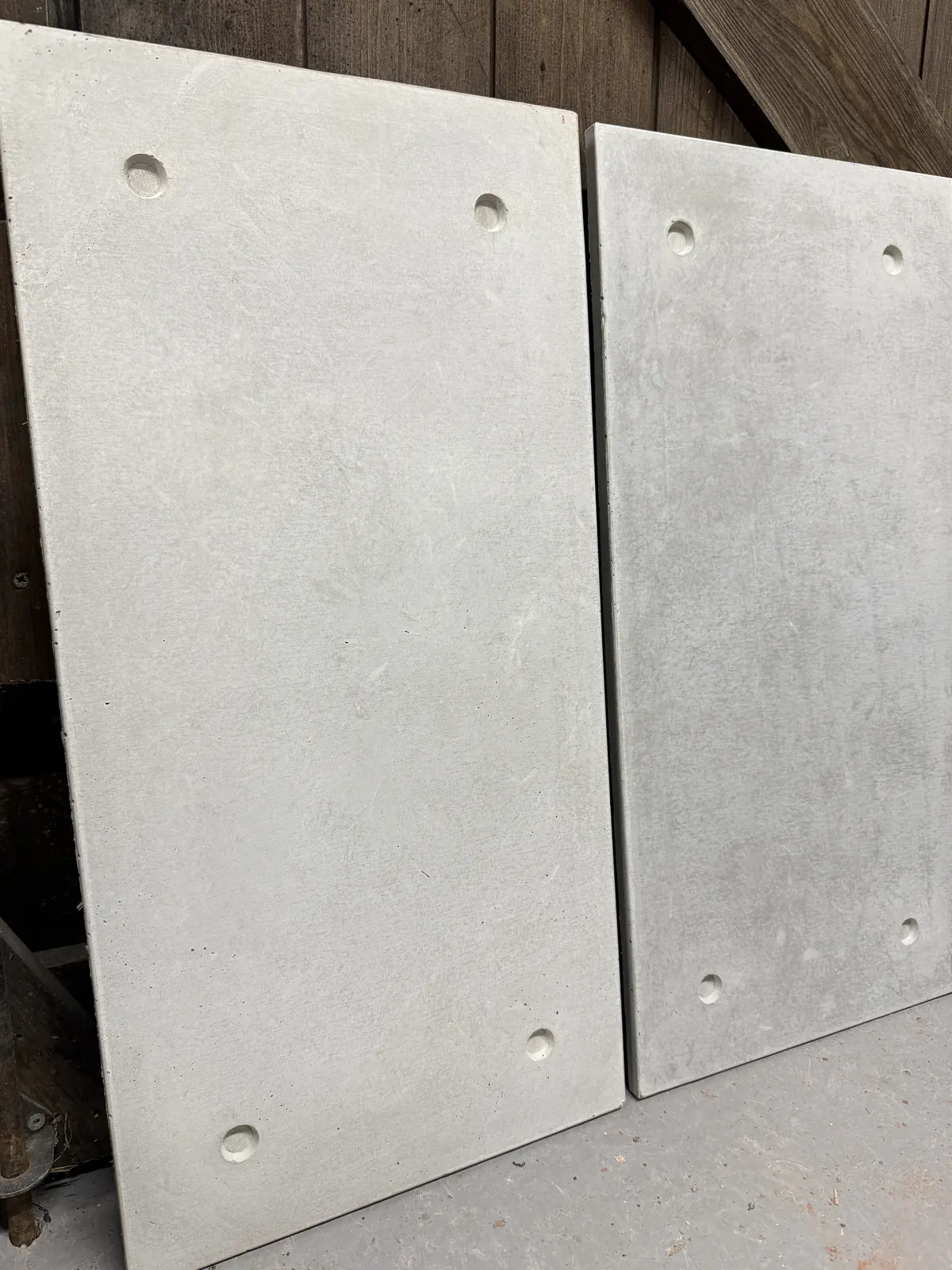
Why are there holes in the face?
Look at any large precast or cast-in-place concrete building and you'll see the tie holes. Neat marks in a grid, where steel ties held the two sides of the formwork together while the concrete went in, each one capped with a small cone that leaves a clean recess when the forms come off.
Most builders fill them. The Japanese architect Tadao Ando made them the point. His walls are cast against formwork panels of about 900 × 1800 mm, the proportion of a tatami mat, each panel carrying six tie holes in two rows of three, set with absolute regularity. The only decoration on the wall is the record of how it was made.
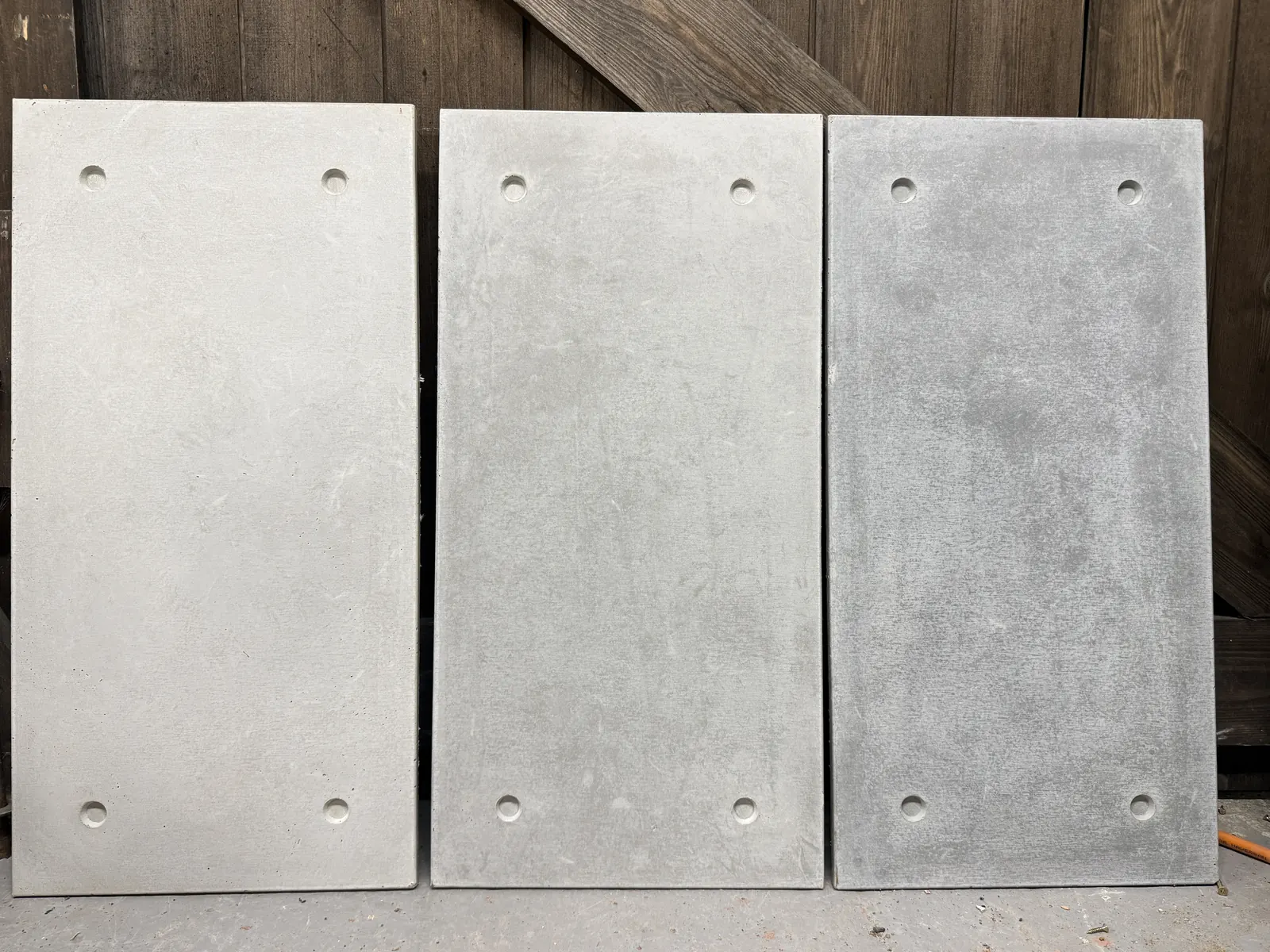
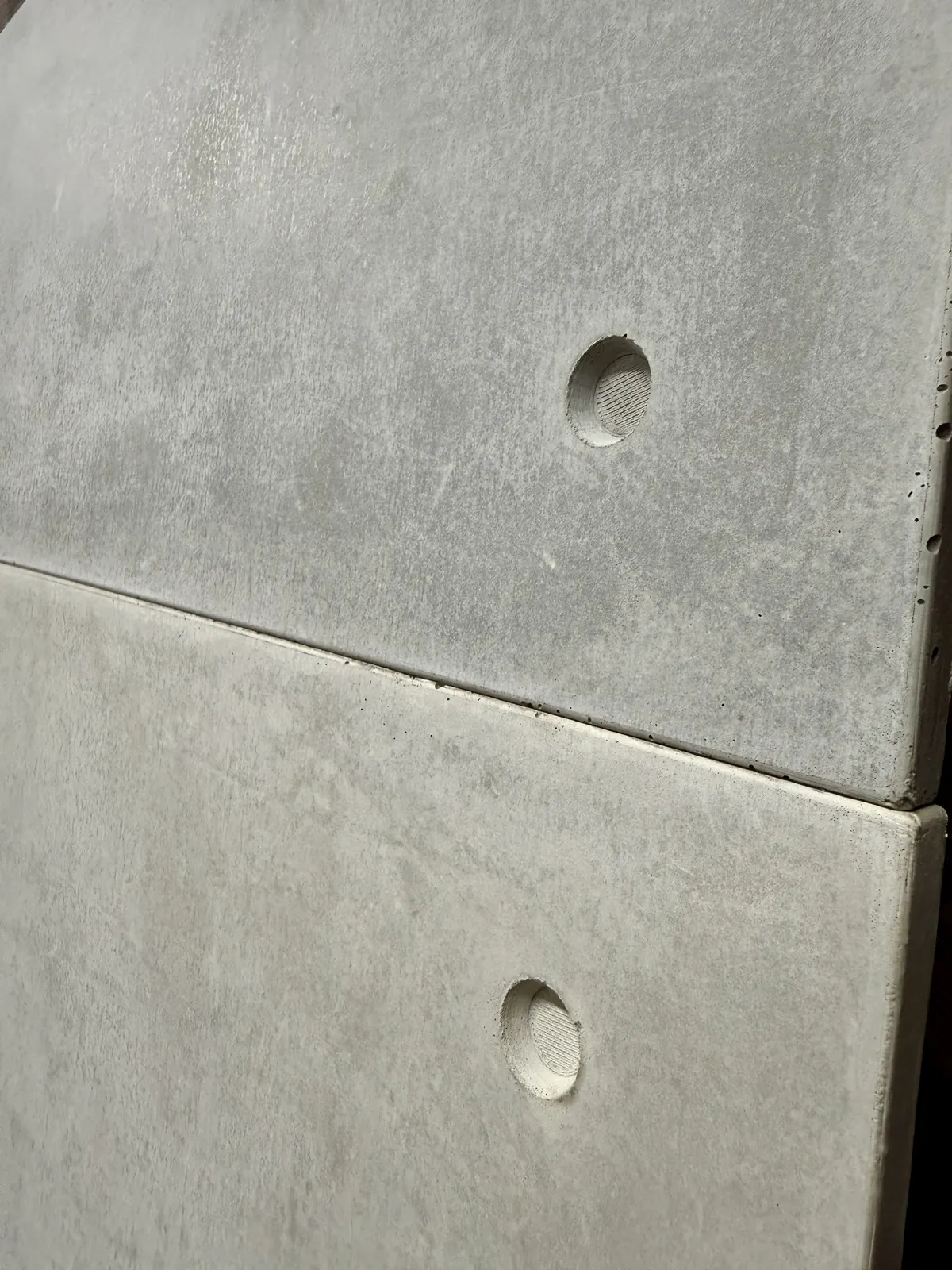
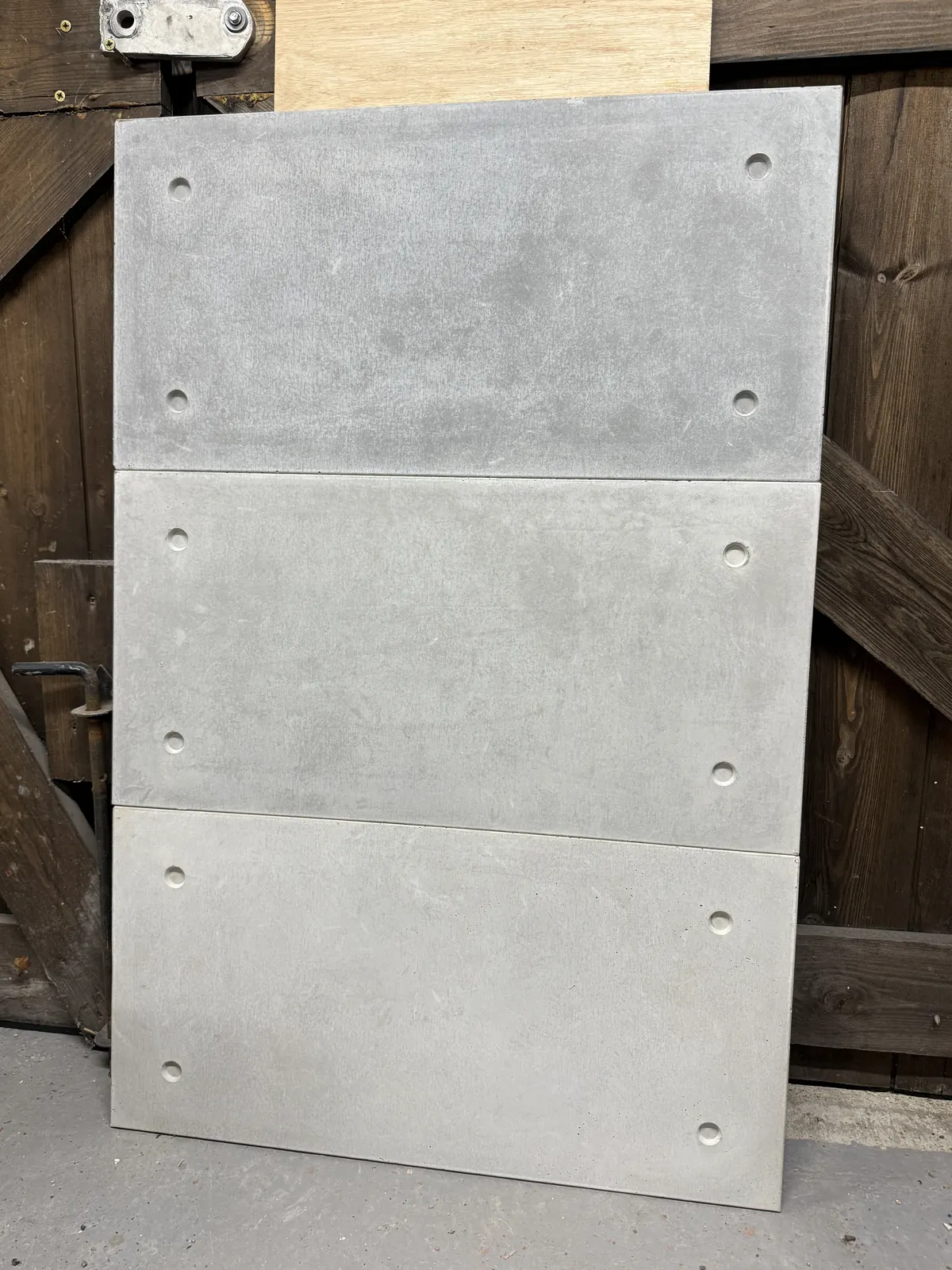
Our tile takes that idea and scales it. A tile is 600 × 1200 mm, the same 1:2 proportion as Ando's panel, and carries four holes, one 75 mm in from each corner, cast with a 3D-printed former so every one comes out the same crisp shape. The tile is the block, and the line between tiles is the block joint, so a clad wall reads as a stacked bond of large blocks, each with its own tie marks.
They earn their keep too. Where a wall needs a mechanical fixing, the screw goes through them. More on that below.
What are they made of?
GFRC. Cement, fine sand and alkali-resistant glass fibre, mixed here from our own formulation rather than a bought-in premix. The fibre runs right through the section, which is what lets a tile go to 12.5 mm with no steel inside it. What GFRC is, if you want the longer answer.
A full tile weighs about 20 kg, roughly 27.5 kg per square metre. Light enough to bond to a wall without a rail or subframe.
What does the surface look like?
Concrete. Not the honed, flat face of a worktop.
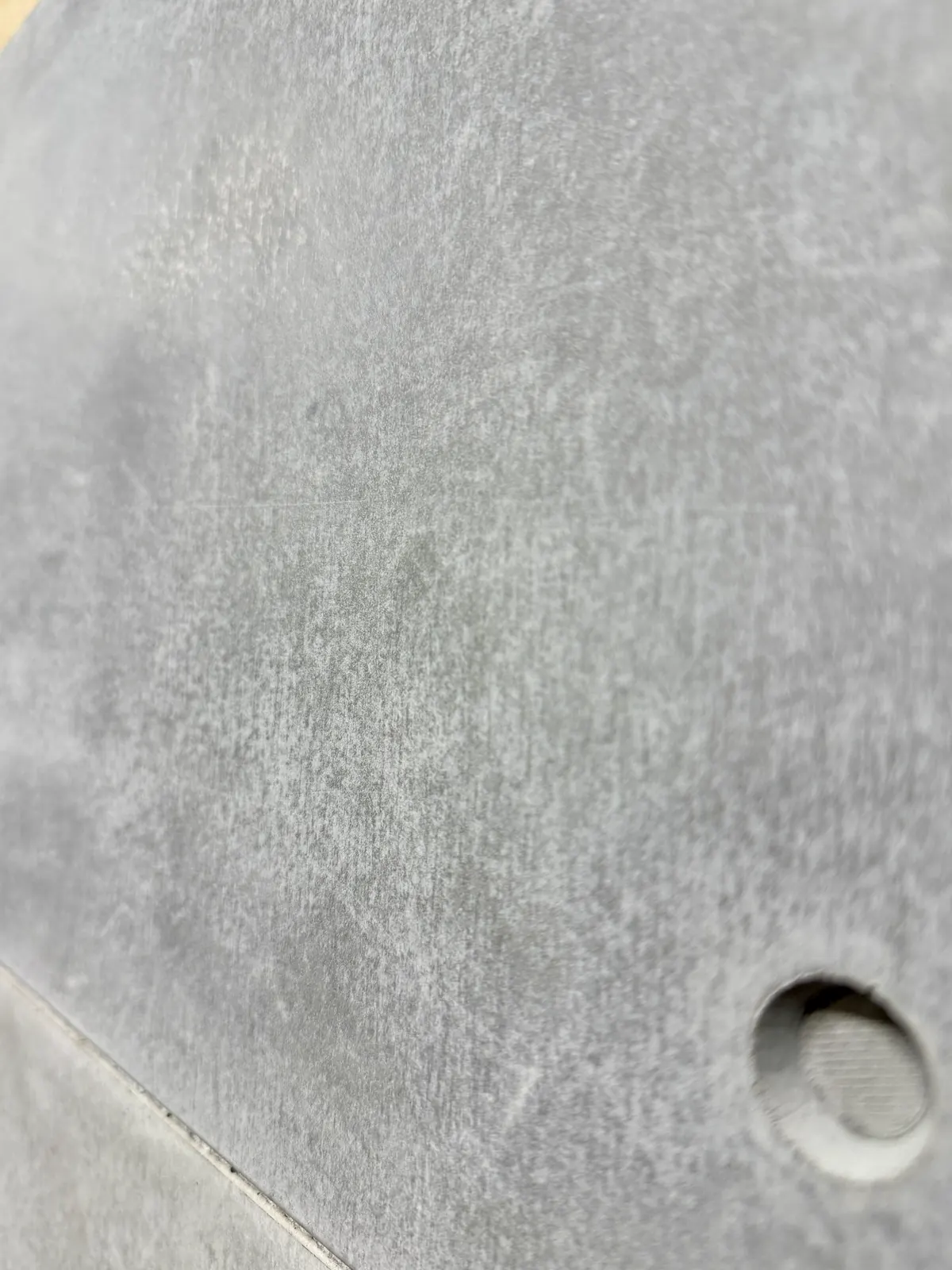
We cast these to read like precast: a soft mottle, a little variation from tile to tile, the odd pinhole. It's designed into the mix and the mould, and it's stable once sealed, so the wall you sign off is the wall you keep.
Every edge has a 1.5 mm eased arris and a slight draft, so where two tiles meet there's a fine shadow line rather than a hard butt joint.
What colours can I have?
Any of our stock colours, around thirty, or a match to a sample, a paint reference or a fabric. Cladding takes colour the same way our worktops do, because it's the same concrete.
Three greys are in the photo above, pale to dark. Concrete reads darker wet, so we don't judge a colour until it's had a week to dry and a coat of sealer. Why fresh concrete looks wrong until it's dry.
How do they fix to the wall?
Bonded. A tile this light goes straight onto a prepared, low-absorption substrate with an exterior-rated adhesive, the way brick slips go up. No rails, no subframe, no drilling into the tile.
High on a wall, or wherever the spec calls for a mechanical fixing as well, we add a screw through each of the four tie holes into a plug or batten behind, on top of the adhesive. The holes were cast for it. We'll confirm the fixing for your wall when we quote it.
Can they go outside?
Yes. They're built for it.
The mix is dense and low in porosity, with the fibre through it, which is what gives GRC its resistance to frost, and the pigments are inorganic oxides, so sunlight doesn't fade them. What weathers over the years is the surface: a little dirt, rain marks, maybe a chalky bloom in the first year that washes off. What the bloom is and why it's cosmetic.
How much does concrete cladding cost?
£90 a tile. A 600 × 1200 mm tile covers 0.72 m², so that's about £125 a square metre for the tiles; fixing is priced for the wall and the journey. Send us the wall size and a photo and we'll quote it.
Contact us for bulk pricing, custom colours, styles and sizes, site visits, estimates, CAD design and rendering. All doable on request.
Is it guaranteed?
Yes. Every cladding tile we make and fit has the same five-year cover as our worktops. In year one, we remake any tile with a mixing, casting or fixing fault. In years two to five, we repair it to a sound, sealed, colour-matched finish.
Concrete can't be matched exactly, so a repair may look a shade different. If a repair can't reach that standard, or the same crack comes back, we remake the tile instead. Colour and texture match your approved sample, allowing for the natural variation in cast concrete.
Read the full guarantee.
How long does it take?
About four weeks from order for most walls; a big one takes a little longer. Every tile is cast, cured and sealed here before it goes on the van.
Can I see one first?
Yes. Order free samples: five 50 mm tablets in our colours, posted anywhere in the UK. For cladding we also cast a 300 × 600 mm sample tile with the holes in, so you can see the block at something close to scale. That one's free too, but get in touch first rather than ordering it from the samples page: we'd usually bring it to you, measure the wall while we're there and talk the fixing through. Measuring, tile counts and a CAD drawing cost nothing.
Do you work with architects and builders?
Yes. Send drawings and we'll come back with tile counts, weights, a CAD drawing and the fixing spec for your wall. How we work with trade.
Where do you work?
Anywhere in the UK, for now. We fix the tiles ourselves and price the install for the journey, so tell us where the wall is and we'll build that in. Tiles travel better than a worktop does.
Tell us about the wall
Send the size, a photo and where it is, inside or out. We'll reply within two working days with a quote and a lead time.