'/%3e%3cpolygon%20points='228.5%20230%20228.5%20811.9%200%20811.9%200%20458.4%20228.5%20230'%20fill='rgb(53,%2053,%2049)'/%3e%3cpath%20d='M814.6,227.1C813.9,101.5,711.9,0,586.2,0H0v228.5h586.2v356.3l228.5-228.5v-129.2h0Z'%20fill='rgb(53,%2053,%2049)'/%3e%3cpath%20d='M308.4,1111.8c-25.2,4.5-51.7-.6-71.5-16.8-13.6-11.2-22.6-26.9-25.7-44.3-1.7-9.5-1.7-19-.3-28.6,4.8-31.7,28.7-55.4,59.8-62.2,13.2-2.9,26.6-2.9,39.8-.2,31.2,6.5,55.4,30.2,60.5,61.8,1.5,9.6,1.5,19.1,0,28.6-5.4,32.2-30.4,55.8-62.6,61.6ZM302.2,1085.3c18-3.6,30.7-16.8,35-34.3,2.4-10.1,2.4-20.5,0-30.6-1.8-8-5.5-15.1-11-21.1-11.4-12.7-29.2-16.9-45.8-13.6-18.1,3.6-31.3,16.8-35.5,34.8-2.3,10-2.3,20.3,0,30.3,2,8.7,6.2,16.5,12.5,22.8,11.6,11.5,28.7,14.9,44.7,11.8Z'%20fill='rgb(53,%2053,%2049)'/%3e%3cpath%20d='M89,1047.2l39.9,62.9h-36.5c0,0-36.4-61.5-36.4-61.5h-23.5s0,61.5,0,61.5H1.1s0-149.2,0-149.2h74.9c5.9,0,11.4.9,16.9,2.4,18,5.3,31,19.3,32.1,38.3.4,6.6-.3,12.8-2.5,19-5.7,14.9-18.3,23.2-33.5,26.6ZM91.8,1000.8c-1.2-6.2-5.6-10.8-11.5-12.8-3.2-1-6.3-1.4-9.7-1.5h-38.1s0,38.6,0,38.6h39.7c3.6-.3,6.8-.8,9.9-2.2,8.8-3.9,11.4-12.9,9.6-22.1Z'%20fill='rgb(53,%2053,%2049)'/%3e%3cpath%20d='M771,1075.3h-65.1s-12.7,34.9-12.7,34.9h-33s59.2-149.2,59.2-149.2h39.6s59.8,149.2,59.8,149.2h-35s-12.6-34.9-12.6-34.9ZM762.5,1050.9l-24.4-63.8-23.7,63.8h48Z'%20fill='rgb(53,%2053,%2049)'/%3e%3cpolygon%20points='528.8%201032.8%20594.1%201110.2%20553.5%201110.2%20496.4%201041.2%20496.4%201110.2%20464.7%201110.2%20464.7%20961%20496.4%20961%20496.5%201028.6%20549.4%20960.9%20586.5%20961%20528.8%201032.8'%20fill='rgb(53,%2053,%2049)'/%3e%3c/svg%3e)


By ROKA Studio
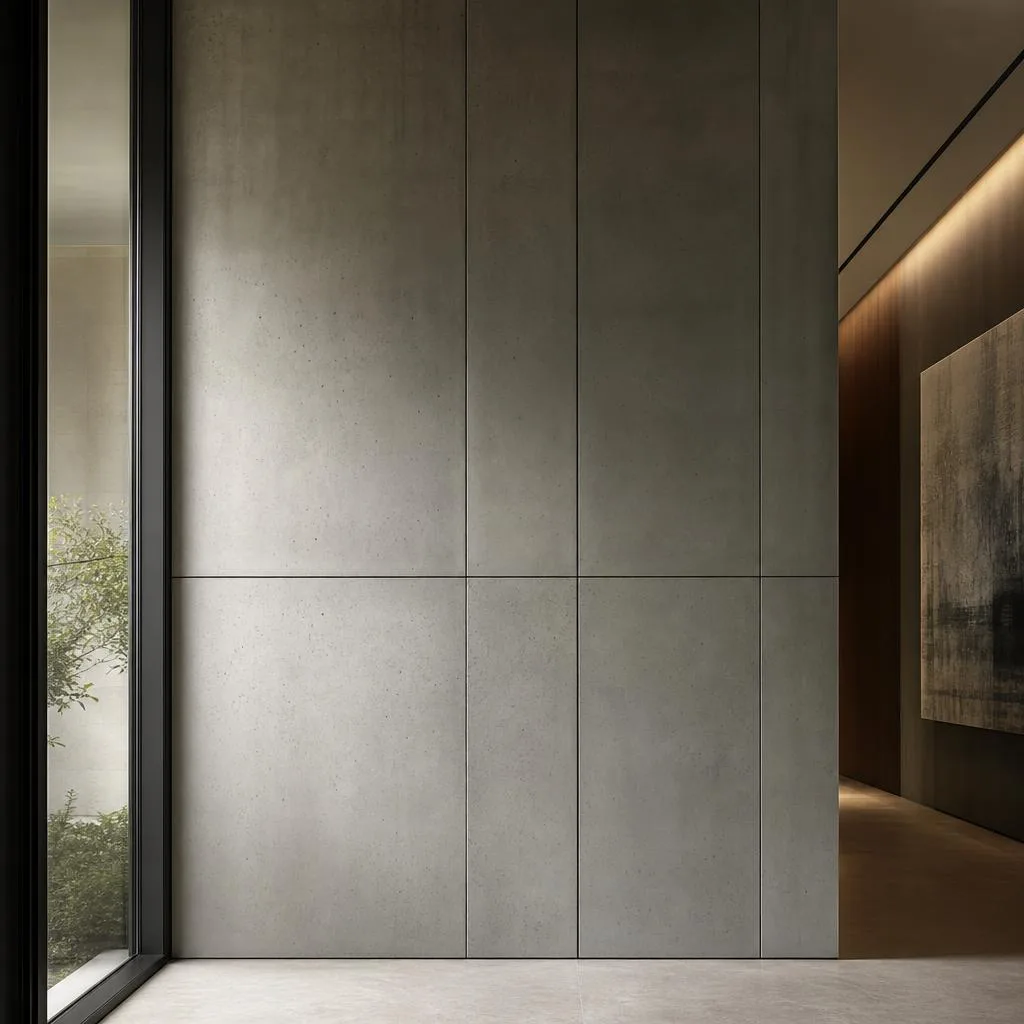
"GFRC" turns up across this site without much explanation, so here it is plainly: Glass Fibre Reinforced Concrete. It's the material behind a ROKA worktop, most of our cladding, and every sample tablet we send out — and it isn't the same stuff as a driveway or a garden wall.
What is GFRC, exactly?
A cement and fine sand mix — no coarse stone aggregate — with alkali-resistant glass fibres dispersed straight through it instead of steel bar. The fibres go in with the mix rather than being laid as sheets, so there's no cage to work round and no minimum thickness needed to bury metal safely inside. That's what lets a panel run thin: ours run about 10–13mm, against the 100mm-plus a structural slab needs.
Why glass instead of steel?
Steel rusts, and rusting steel expands and cracks the concrete around it — which is why ordinary reinforced concrete needs 25–50mm of cover just to protect the bar. Glass fibre doesn't corrode, so it can sit close to the surface. It has to be a specific type, though: alkali-resistant (AR) glass, because ordinary glass fibre breaks down in the highly alkaline environment inside curing cement.
Is all GFRC the same?
Same idea, different mix, every workshop. Cement type, sand grade, fibre length and dose, plasticiser and pigment are all tuned to what's being cast, so one maker's GFRC can look, feel and perform differently from another's.
GFRC or UHPC — what's the difference?
Both are modern high-performance concretes built for different jobs. GFRC is light, casts thin and demoulds fast — ours within 24 hours — which suits worktops, furniture and cladding where weight and finish matter most. UHPC (ultra-high-performance concrete) trades that ease for very high compressive strength and one-piece casting with no seams, at the cost of a fussier mix and a slower cure — it's built for harsh outdoor or structural work. Where that line falls for us is a post of its own.
Does GFRC weather like ordinary concrete?
Largely yes — it's still a cement-based material, so it inherits concrete's usual behaviours: it looks darker while it's drying, it can develop a light chalky bloom outdoors in its first year, and its final colour only settles once it's fully cured and sealed.
See the colours and finishes for yourself.
Order free samples