


By ROKA Studio
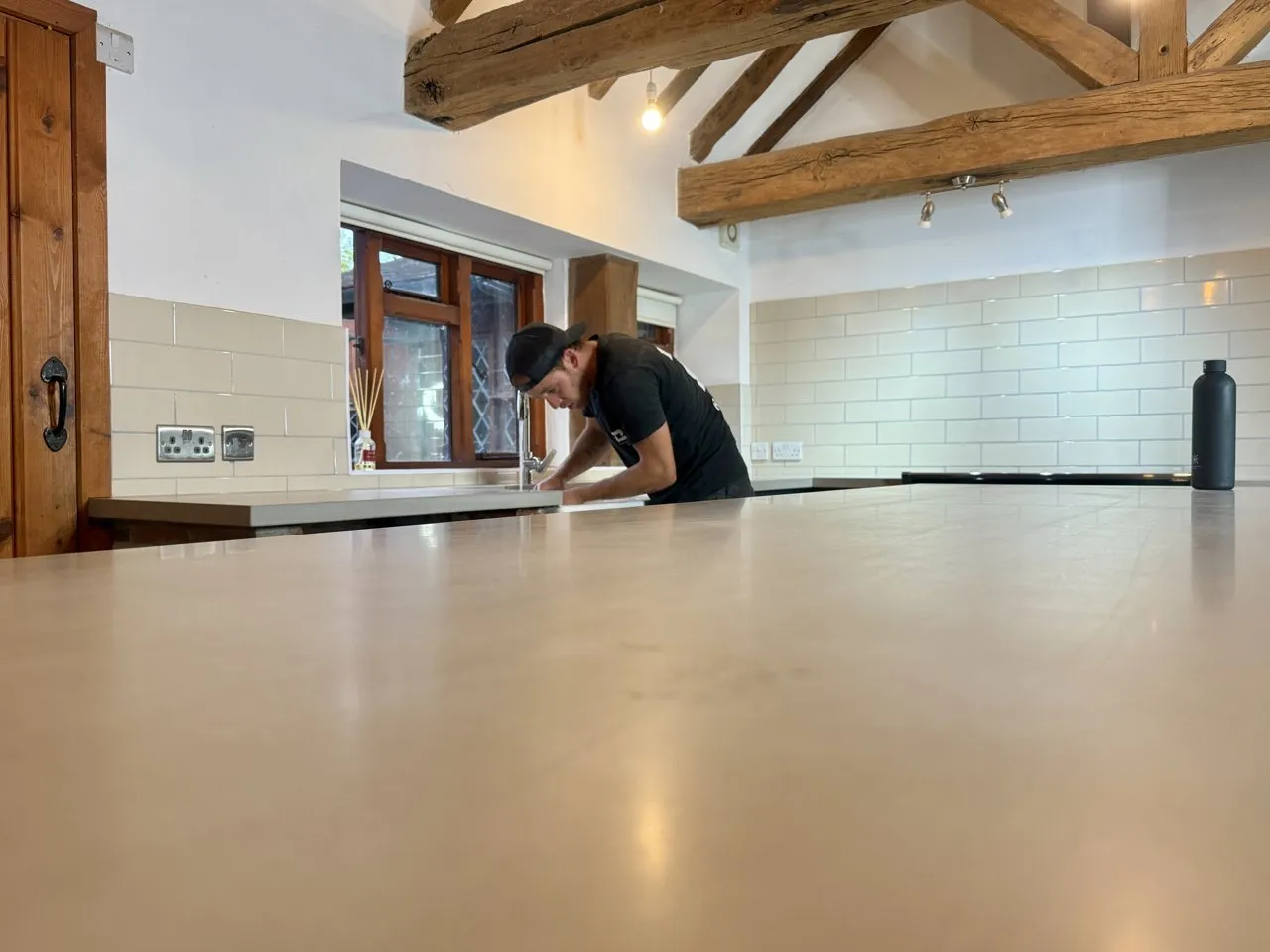
A waterfall island is an island where the worktop doesn't stop at the edge. It carries on down the side to the floor, like water running over a ledge. In concrete, the top and the end can be one cast piece, with no mitre joint where they meet, so the colour runs unbroken from the surface to the floor.
What is a waterfall island?
It's a single idea with two parts. The top lies flat, and one or both ends fold down as a vertical face. In stone, those two parts are usually cut and joined at the corner. In cast concrete, they're made together in a mould, so the corner is part of the piece and not a seam you'd learn to see.
Why choose a waterfall end?
For the look, first. The top meets the floor, and you see it the moment you walk in, the way you'd see a piece of furniture. For protection, too. The side of an island takes bags, boots and stools, and a hard-wearing face there saves the cabinets behind it. And it frames the island, showing where the stools go and giving it a clear edge.
How is a waterfall island made in concrete?
We build the mould to your template. A wall that leans or an angle that isn't 90 degrees goes into the mould. So the finished top fits the room you actually have.
Too big to get through the door? We cast it in the room. That's how the one-piece waterfall island in a converted barn in Steyning was made. It's GFRC, cast on site in the kitchen, and it never had to be carried in.
What colour and finish can a waterfall island have?
Any of our nineteen named colours, in either finish, at the same price. Cream comes straight from the mould and is sealed, with the deepest colour and a flat, even face. Salt and pepper is diamond-finished to 800 grit, so the fine sand shows. The colour is in the concrete itself, not painted on, so a long vertical face reads as one material from top to bottom.
Can a waterfall island have a sink and a hob?
Yes. A sink can be cast into a made-to-size top, with drainer grooves cast in beside it. A hob goes in as a cut-out. The same seal covers all of it. It's SureCrete XS-327, rated to 149°C, so a pan of boiling pasta goes straight down.
What does a waterfall island cost, and how long does it take?
Worktops are £850 per m² up to 30mm thick, then £15 more per m² for every millimetre above that, so 40mm is £1,000 per m². Typically an island takes 3 to 6 weeks from design sign-off, and every named colour costs the same.
On quoted work, templating, delivery and fitting are priced on top. We template, make and fit our own worktops and islands within about 50 miles of Small Dole, and supply-only pieces go across mainland UK. The ROKA 5-Year Guarantee covers the making. If a piece we make fails through our fault in its first year, we remake it, and up to year five we repair it.
How do you decide?
Start with a sketch of your room and the height you like. Then hold the surface. Order free samples and set them beside your cabinets in your own light.
When you're ready for the shape, the concrete kitchen islands page shows what we cast and how to start a quote.
A waterfall end is where an island stops being a worktop and becomes the room's main piece. Cast in one, it never shows a join.
See the colours and finishes for yourself.
Order free samples