


By ROKA Studio
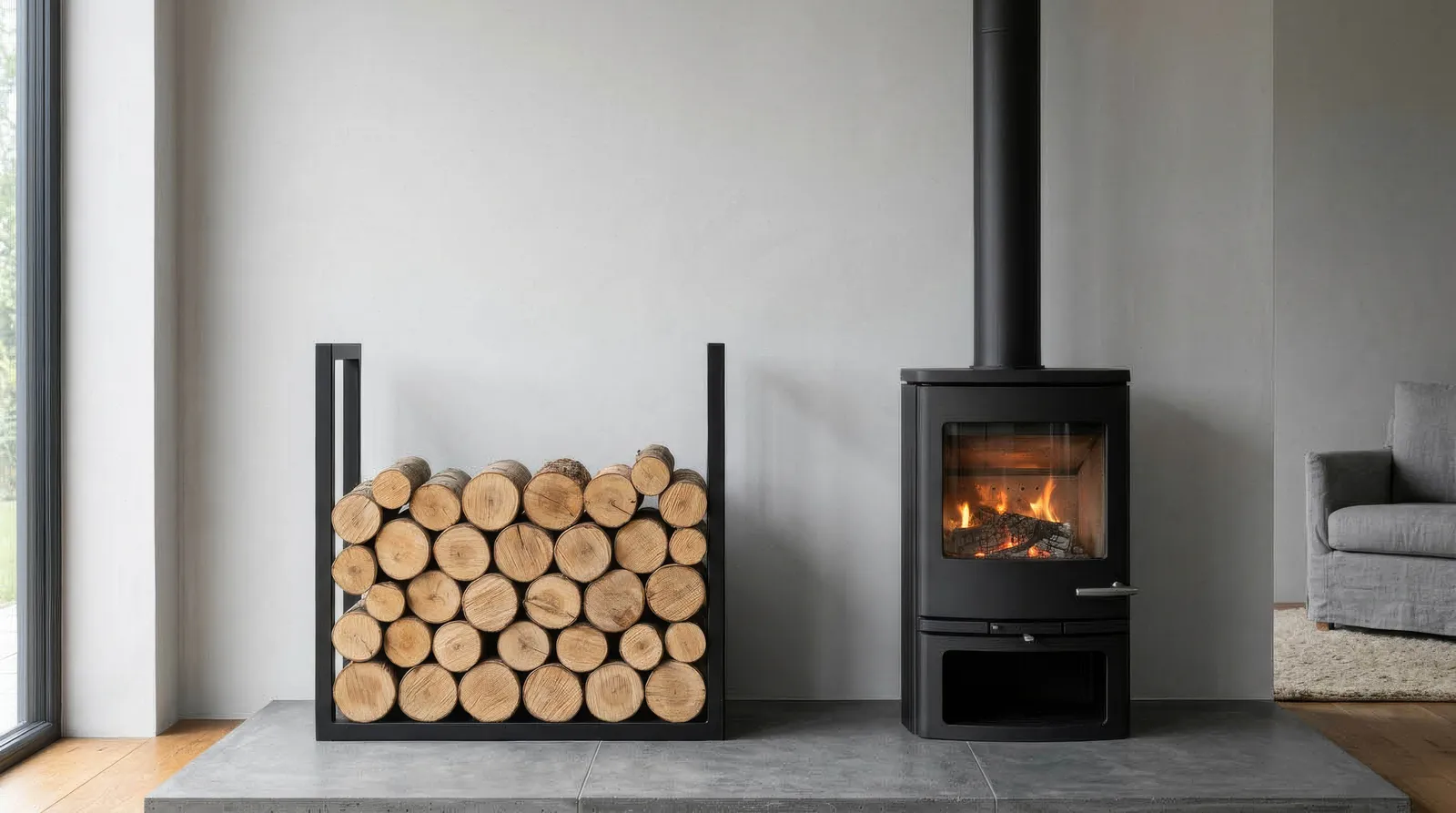
Slate, granite and concrete can all go under a log burner. The rules ask for a size and a thickness, not a particular stone, so the real choice is the look you want and how closely the hearth fits your fireplace. Here's how the three compare once the stove has set the size.
Do slate, granite and concrete all meet the rules?
All three are non-combustible, so all three can. In England the rules sit in Approved Document J. A stove standing in the open needs a constructional hearth at least 840 x 840mm and 125mm thick. There's a thinner route. A stove that's been tested to keep its hearth under 100°C can stand on one at least 12mm thick. It must reach 225mm in front and 150mm each side.
Your stove's manual can ask for more than the rules do, and your installer signs the hearth off. So the order is stove first, stone second. Our post on hearth thickness for a log burner walks through the two routes with a worked example.
What does each one look like?
Slate is a layered rock, usually dark grey to near black, and it often has a riven face where the layers split. Granite is a hard, speckled stone that's usually polished to a shine. Both come as natural slabs. The pattern you see in the showroom is the pattern of that slab and no other.
Concrete is a made material, so you choose the colour first. We cast in nineteen named colours, from Chalk and Ash through to Graphite, with Ochre and Terracotta for something warmer. The colour is in the concrete itself, not painted on. On an oak floor, a hearth in Bracken or Walnut looks warm against the timber. On a stone floor, a grey in the same tone makes the stove look planned from the start. There are two standard finishes. Cream is straight from the mould and sealed, with the deepest colour and a flat, even face. Salt and pepper is diamond-finished to 800 grit and sealed, so fine sand shows.
What if your fireplace isn't a neat rectangle?
That's where a cast hearth earns its place. Stone is cut from a slab, so an awkward shape means more cuts. We pour a hearth into a mould built to the size you need, so it arrives as one piece made to that size.
Old houses are the usual reason. A chimney breast that's out of square, a stove that sits off centre, a floor that isn't level. Measure the opening before you order, and make sure the hearth is made to what's actually there. Natural stone is a fine choice. It's cut to fit, where ours is cast to fit.
How do they compare on weight and heat?
Weight matters on a timber floor. At the same 30mm thickness, granite is about 80kg a square metre and concrete about 70, so concrete is no heavier than the stone it replaces.
On heat, the seal on our hearths is rated to 149°C, about 50°C hotter than boiling water. A stove tested to the thin-route limit keeps its hearth surface under 100°C. That's well inside what the seal can take. Check the seal once a year. If water stops beading on the surface, it is due a recoat.
How should you choose?
Start with the stove's manual. Then the size. Then the look. When you reach it, put a sample next to your fire in daylight. Colour on a screen and colour in a living room are different things.
A 900 x 900mm hearth at 30mm is about £700 supply only. Sizes, colours and the shop are on our concrete hearths page. Ask for free samples and set one beside your stove before you decide.
See the colours and finishes for yourself.
Order free samples