


By ROKA Studio
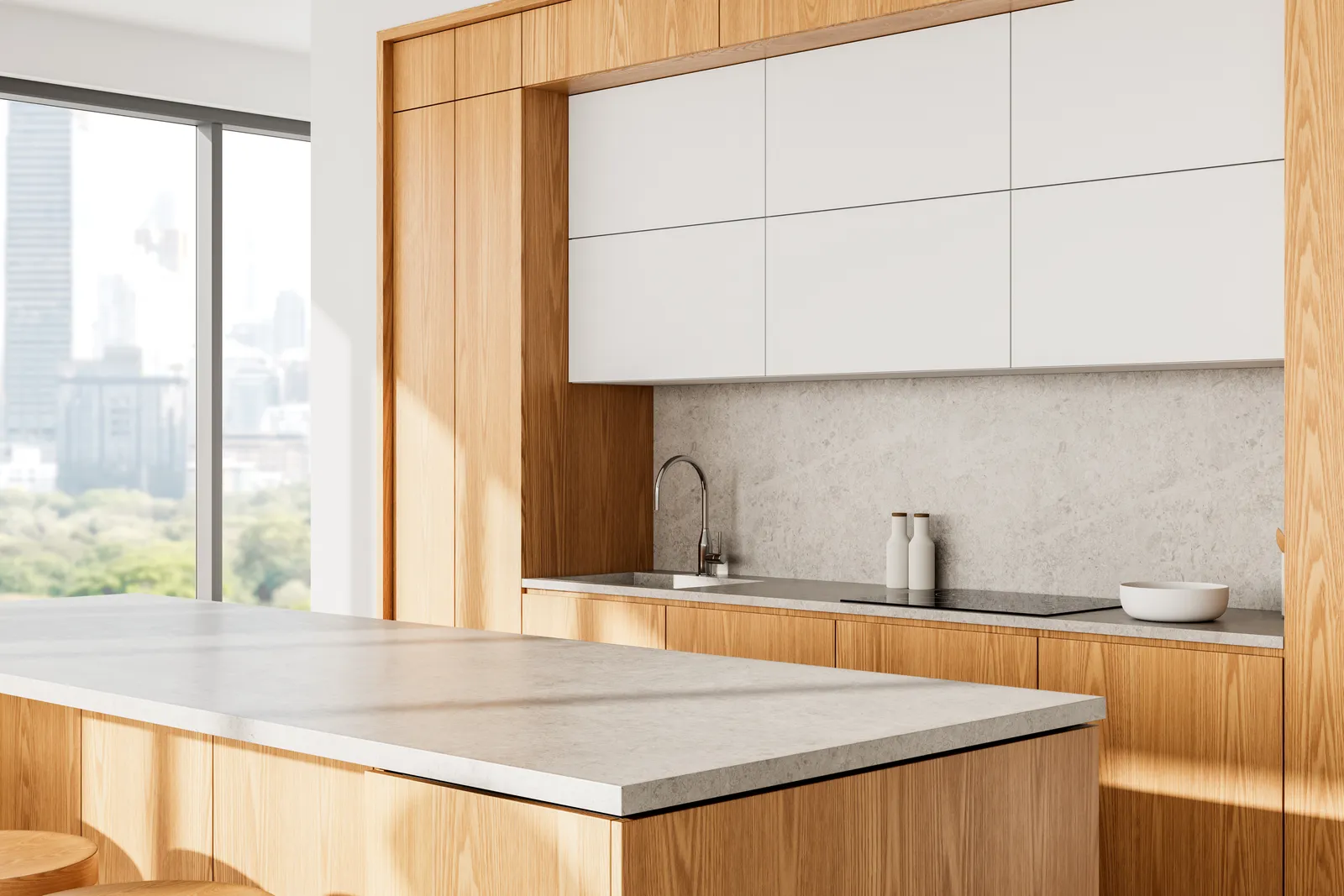
Cement is where the carbon in concrete comes from, and this month the people who make it announced two ways to cut it. If you're choosing a worktop, that's good news for concrete, and it's worth knowing what it changes and what it doesn't.
Is concrete getting greener?
Yes, and the figures are public. The Concrete Centre's 2026 benchmark, reported by CemNet on 5 October, puts the average carbon in UK ready-mixed concrete at 229 kgCO2e per cubic metre for 2025. That's down from 242 the year before. The main reason was wider use of Portland-limestone cement.
According to CemNet, that's a fall of about 5% in one year. It's a slow, steady move, and the kind that lasts.
What's the new low-carbon cement?
Saint-Gobain's Chryso and Ecocem unveiled a cement and admixture pairing at Batimat in October. Ecocem says its ACT cement can cut cement carbon emissions by up to 70%, according to The Construction Index. According to The Construction Index, Chryso says concrete made with the pair can reach a carbon reduction of over 50%.
Both numbers come from the makers, and "up to" means a ceiling. Still, it shows where the industry is heading. The cement is the part that matters, so that's where the work is going.
Why does the cement matter so much?
In any concrete mix, the cement is the ingredient that carries most of the carbon. That's why the news is about cement, and why a cleaner binder is the biggest single step the industry can take.
What does that mean for a concrete worktop?
Today, nothing changes on your quote, and we won't pretend it does. We formulate our own mixes in our workshop in West Sussex, and a worktop is cast to your drawings, so what you order is what we make. The new cements are for the big pours first, like the buildings and bridges the reports are about.
What it does change is the direction of travel. Concrete you buy next year can be better than concrete you could buy last year, and a cast top is a long-term purchase made from it.
Why does a worktop that lasts matter more than the mix?
Because the greenest worktop is the one you don't replace. Concrete doesn't burn or give off smoke. Most of our worktops are cast at full finished thickness, and glass fibre runs through almost every piece. We'd rather build in more strength than a job needs.
If a patch of the seal ever wears, it can be lightly sanded and recoated where it sits. Nobody takes the top out. Behind all of it sits the guarantee. If a piece we make fails through our fault in its first year, we remake it, and up to year five we repair it.
What about the sealer?
We use SureCrete XS-327, a two-part, water-based hybrid polyurethane. It's rated to 149°C, so a pan of boiling pasta goes straight down, and it's stain resistant to most household chemicals and food.
How do you choose well?
Ask any maker the same three questions, ours included, and write the answers next to each quote you get. Where is it made? How long should it last? What happens if it goes wrong? Ours are West Sussex, built to keep, and backed by the ROKA 5-Year Guarantee.
You can see the surface and the seal before you decide. Order free samples, sealed just like a finished top, and put them next to your cabinets and your floor. For the full range of what we cast, start at the concrete worktops page.
Whatever cement goes in next, a top you keep is a top you don't replace.
See the colours and finishes for yourself.
Order free samples