'/%3e%3cpolygon%20points='228.5%20230%20228.5%20811.9%200%20811.9%200%20458.4%20228.5%20230'%20fill='rgb(53,%2053,%2049)'/%3e%3cpath%20d='M814.6,227.1C813.9,101.5,711.9,0,586.2,0H0v228.5h586.2v356.3l228.5-228.5v-129.2h0Z'%20fill='rgb(53,%2053,%2049)'/%3e%3cpath%20d='M308.4,1111.8c-25.2,4.5-51.7-.6-71.5-16.8-13.6-11.2-22.6-26.9-25.7-44.3-1.7-9.5-1.7-19-.3-28.6,4.8-31.7,28.7-55.4,59.8-62.2,13.2-2.9,26.6-2.9,39.8-.2,31.2,6.5,55.4,30.2,60.5,61.8,1.5,9.6,1.5,19.1,0,28.6-5.4,32.2-30.4,55.8-62.6,61.6ZM302.2,1085.3c18-3.6,30.7-16.8,35-34.3,2.4-10.1,2.4-20.5,0-30.6-1.8-8-5.5-15.1-11-21.1-11.4-12.7-29.2-16.9-45.8-13.6-18.1,3.6-31.3,16.8-35.5,34.8-2.3,10-2.3,20.3,0,30.3,2,8.7,6.2,16.5,12.5,22.8,11.6,11.5,28.7,14.9,44.7,11.8Z'%20fill='rgb(53,%2053,%2049)'/%3e%3cpath%20d='M89,1047.2l39.9,62.9h-36.5c0,0-36.4-61.5-36.4-61.5h-23.5s0,61.5,0,61.5H1.1s0-149.2,0-149.2h74.9c5.9,0,11.4.9,16.9,2.4,18,5.3,31,19.3,32.1,38.3.4,6.6-.3,12.8-2.5,19-5.7,14.9-18.3,23.2-33.5,26.6ZM91.8,1000.8c-1.2-6.2-5.6-10.8-11.5-12.8-3.2-1-6.3-1.4-9.7-1.5h-38.1s0,38.6,0,38.6h39.7c3.6-.3,6.8-.8,9.9-2.2,8.8-3.9,11.4-12.9,9.6-22.1Z'%20fill='rgb(53,%2053,%2049)'/%3e%3cpath%20d='M771,1075.3h-65.1s-12.7,34.9-12.7,34.9h-33s59.2-149.2,59.2-149.2h39.6s59.8,149.2,59.8,149.2h-35s-12.6-34.9-12.6-34.9ZM762.5,1050.9l-24.4-63.8-23.7,63.8h48Z'%20fill='rgb(53,%2053,%2049)'/%3e%3cpolygon%20points='528.8%201032.8%20594.1%201110.2%20553.5%201110.2%20496.4%201041.2%20496.4%201110.2%20464.7%201110.2%20464.7%20961%20496.4%20961%20496.5%201028.6%20549.4%20960.9%20586.5%20961%20528.8%201032.8'%20fill='rgb(53,%2053,%2049)'/%3e%3c/svg%3e)


By ROKA Studio
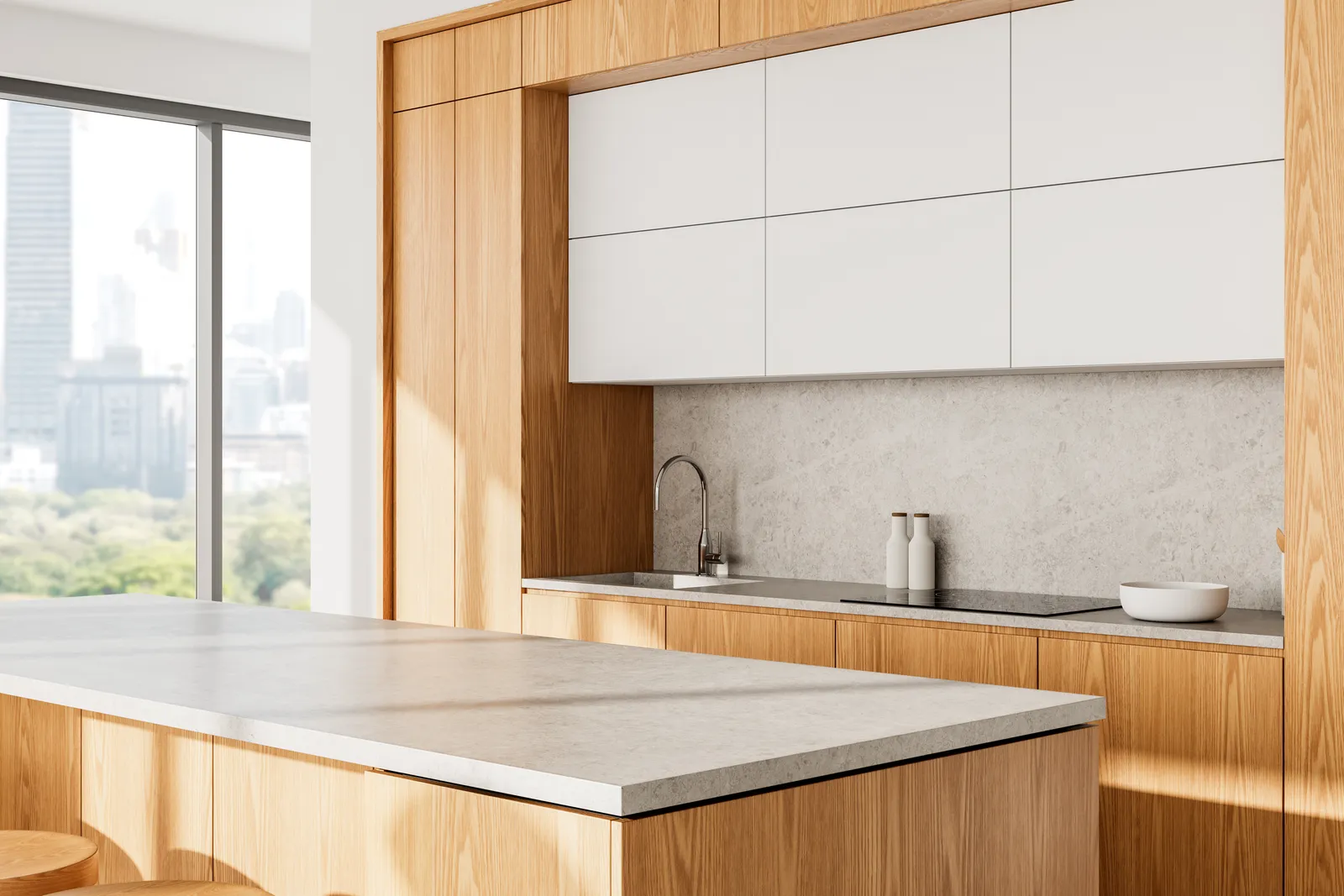
Microcement is a thin coat trowelled onto a surface that's already there. A ROKA worktop is a solid piece of concrete, cast in a mould in our workshop and sealed. That's the whole difference, and most of the others follow from it.
What is microcement?
A cement-based coating, put on by hand in layers over an existing surface, then sealed. You'll see it used over old worktops, walls and floors. The surface underneath carries it, and the coat gives that surface a concrete look.
That makes it a finish for something you already have. Whether it suits your kitchen depends on what's under it and on the person applying it.
What is a cast concrete worktop?
It's a new piece, made for your kitchen. We template the room and cast the top to the template, so an odd wall angle, a drainer groove or a waterfall end comes out of the mould as part of the piece. The mixes are formulated in-house, in GFRC and UHPC, and most of our worktops are cast at full finished thickness.
The top is sealed with SureCrete XS-327. We don't trowel anything over a base. The piece is solid.
Which one is right for your kitchen?
If you want to change the look of a surface you're keeping, that's a job for a coating like microcement. We don't do it. We don't coat existing worktops.
If you want a new worktop, made to fit, with its own shape and edges, that's what we cast. Take the converted barn kitchen in Steyning. The island there is a one-piece waterfall, cast on site in the kitchen itself. A coating follows the shape of whatever is underneath it. A cast piece is the shape. We make the concrete and work alongside your kitchen maker or fitter.
Does a coating peel?
It's a fair worry. A coating stays on only as well as it's bonded to what's underneath, and that comes down to preparation and application.
A cast piece isn't a coating over something else, so there's nothing to peel. A crack is a different matter. A cracked worktop is a failure, not character, and the ROKA 5-Year Guarantee opens with this line.
"If a piece we make fails through our fault in its first year, we remake it, and up to year five we repair it."
That covers the making. The guarantee also lists what it doesn't cover, and seal wear after year one is on that list. Whoever you buy from, ask them to put both lists in writing, so you know what is covered and what isn't.
What should you ask a microcement installer?
Four things. What is the surface underneath, and is it sound? How many coats go on, and how long between them? What is the finished surface sealed with? And what does the guarantee say, in writing, if the coat lifts?
You're asking the same questions of us. A fair comparison needs the same answers from both sides, so write them down side by side.
How do you compare them properly?
Look at samples in both. Ours are sealed exactly as a worktop is, in both finishes, and they're free. Cream is straight from the mould, with the deepest colour and a flat, even face. Salt and pepper is diamond-finished to 800 grit, so fine sand shows.
Ask any maker what's under the finish, how thick it is and what the guarantee says in writing. Our answers are on the page for concrete worktops, and you can order free samples to hold next to whatever else you're looking at.
See the colours and finishes for yourself.
Order free samples