


By ROKA Studio
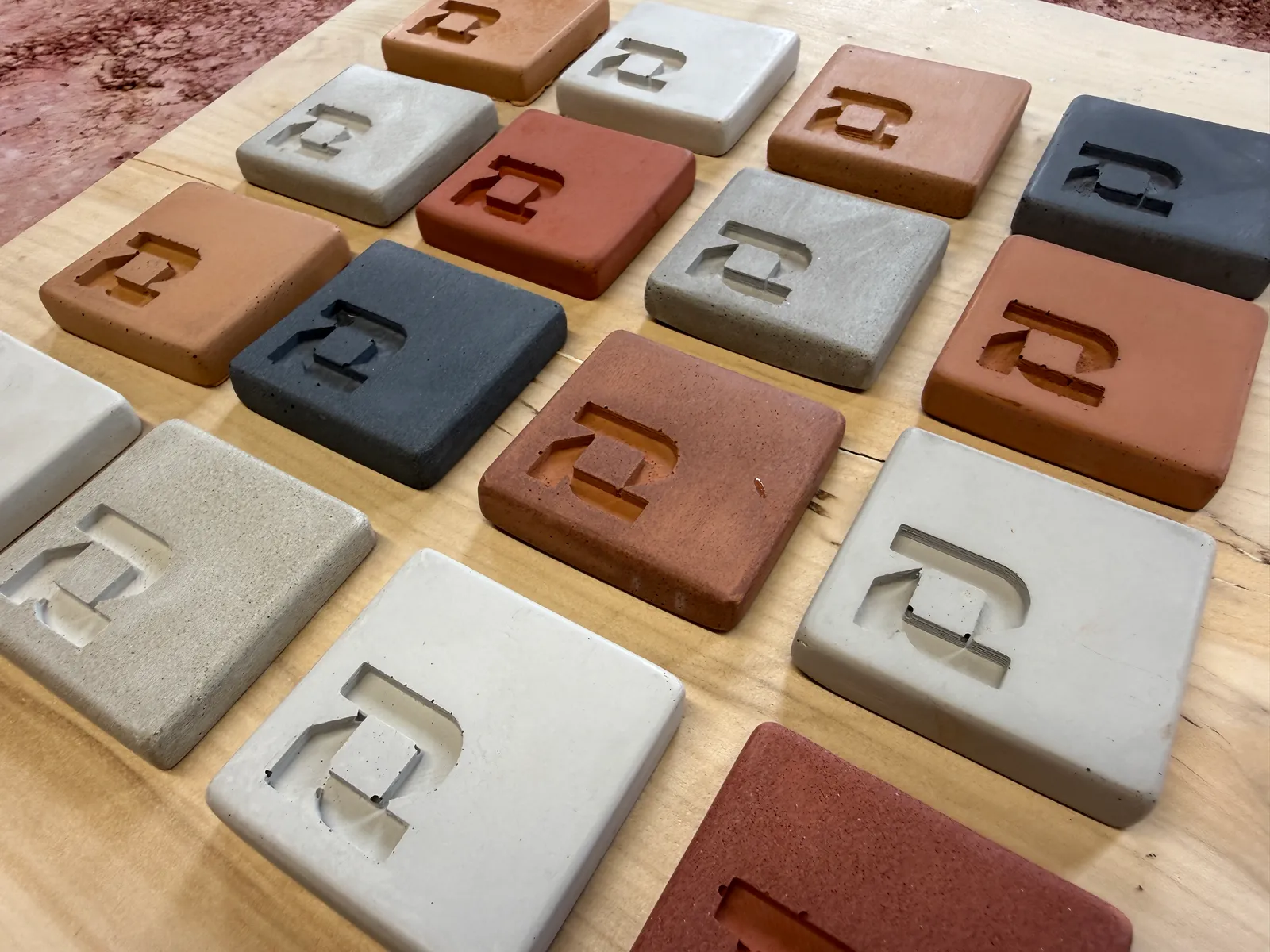
A grey concrete worktop isn't one grey. We name nine of them, from Chalk, the lightest, to Basalt, the darkest, and the one you pick changes the feel of the whole kitchen. Here's how to get from nine to one, and what white and black look like beside them.
How many concrete worktop colours are there?
Nineteen named colours. Nine are greys, two are whites and eight are earths. Every one is a real colour you can hold, because the colour is in the concrete itself, not painted on.
Every named colour costs the same, in either finish, and a custom match is offered too at a higher price. That means you can choose on looks alone, and nobody nudges you towards a cheaper shade.
What decides the colour of concrete?
In any concrete, the colour comes from the cement, the fine sand and any pigment that goes in. A pale base gives cleaner light colours, and a darker base gives deeper, earthier ones. We formulate our mixes in-house, so each named colour is a mix we've worked out for ourselves, not a paint chart match.
That's also why photographs on a screen only get you so far. A screen can't show how fine sand catches the light, or how a sealed surface looks when the sun comes round to the window.
Which grey should you choose?
Read the greys as three steps. The light ones are Chalk, Ash and Dove. They bounce daylight round a room, and they suit a small kitchen or a north-facing one. The middle ones are Pewter, Flint and Storm. They sit well between oak and white cabinets. The dark ones are Slate, Graphite and Basalt, and they give a kitchen weight.
Pick a step first, then a name. It's far easier to choose between three greys than nine, and your eye will tell you which step is right the moment you hold the samples up to your cabinets.
Can you have a white concrete worktop?
Yes. Portland and Bone are our two whites, and both are pale and soft rather than bright, so they read as concrete and not as gloss. If you like the look of a pale worktop but want something with depth, start there.
Can you have a black concrete worktop?
Basalt is the darkest colour we name. If you want something deeper still, send us a photo of what you've seen and we'll talk it through.
Does the finish change the colour?
Yes, a little, because we offer two standard finishes and each one treats the surface differently. Cream comes straight from the mould and is sealed. It gives the deepest colour and a flat, even face. Salt and pepper is diamond-finished to 800 grit and sealed, and fine sand shows in the surface.
So the same grey reads slightly differently in each. That's why a sample in both finishes is worth the postage, and it costs you nothing.
How do you choose without guessing?
Order the samples. They're free, posted anywhere in the UK or delivered in person around Brighton and Sussex. Hold them against your cabinets and your floor in your own light. The colour is in the concrete itself, not painted on.
Set them on your cabinet doors and next to your floor. Look at them in the morning and again at six in the evening, because grey moves with the light. Worktops must match the signed-off sample, so the colour you hold is the colour you get.
Order your free samples once you've narrowed it to a few. To see how the two finishes differ in detail, read the concrete worktop finishes page.
Pick the step, then the name. Then hold it.
See the colours and finishes for yourself.
Order free samples