'/%3e%3cpolygon%20points='228.5%20230%20228.5%20811.9%200%20811.9%200%20458.4%20228.5%20230'%20fill='rgb(53,%2053,%2049)'/%3e%3cpath%20d='M814.6,227.1C813.9,101.5,711.9,0,586.2,0H0v228.5h586.2v356.3l228.5-228.5v-129.2h0Z'%20fill='rgb(53,%2053,%2049)'/%3e%3cpath%20d='M308.4,1111.8c-25.2,4.5-51.7-.6-71.5-16.8-13.6-11.2-22.6-26.9-25.7-44.3-1.7-9.5-1.7-19-.3-28.6,4.8-31.7,28.7-55.4,59.8-62.2,13.2-2.9,26.6-2.9,39.8-.2,31.2,6.5,55.4,30.2,60.5,61.8,1.5,9.6,1.5,19.1,0,28.6-5.4,32.2-30.4,55.8-62.6,61.6ZM302.2,1085.3c18-3.6,30.7-16.8,35-34.3,2.4-10.1,2.4-20.5,0-30.6-1.8-8-5.5-15.1-11-21.1-11.4-12.7-29.2-16.9-45.8-13.6-18.1,3.6-31.3,16.8-35.5,34.8-2.3,10-2.3,20.3,0,30.3,2,8.7,6.2,16.5,12.5,22.8,11.6,11.5,28.7,14.9,44.7,11.8Z'%20fill='rgb(53,%2053,%2049)'/%3e%3cpath%20d='M89,1047.2l39.9,62.9h-36.5c0,0-36.4-61.5-36.4-61.5h-23.5s0,61.5,0,61.5H1.1s0-149.2,0-149.2h74.9c5.9,0,11.4.9,16.9,2.4,18,5.3,31,19.3,32.1,38.3.4,6.6-.3,12.8-2.5,19-5.7,14.9-18.3,23.2-33.5,26.6ZM91.8,1000.8c-1.2-6.2-5.6-10.8-11.5-12.8-3.2-1-6.3-1.4-9.7-1.5h-38.1s0,38.6,0,38.6h39.7c3.6-.3,6.8-.8,9.9-2.2,8.8-3.9,11.4-12.9,9.6-22.1Z'%20fill='rgb(53,%2053,%2049)'/%3e%3cpath%20d='M771,1075.3h-65.1s-12.7,34.9-12.7,34.9h-33s59.2-149.2,59.2-149.2h39.6s59.8,149.2,59.8,149.2h-35s-12.6-34.9-12.6-34.9ZM762.5,1050.9l-24.4-63.8-23.7,63.8h48Z'%20fill='rgb(53,%2053,%2049)'/%3e%3cpolygon%20points='528.8%201032.8%20594.1%201110.2%20553.5%201110.2%20496.4%201041.2%20496.4%201110.2%20464.7%201110.2%20464.7%20961%20496.4%20961%20496.5%201028.6%20549.4%20960.9%20586.5%20961%20528.8%201032.8'%20fill='rgb(53,%2053,%2049)'/%3e%3c/svg%3e)


By ROKA Studio
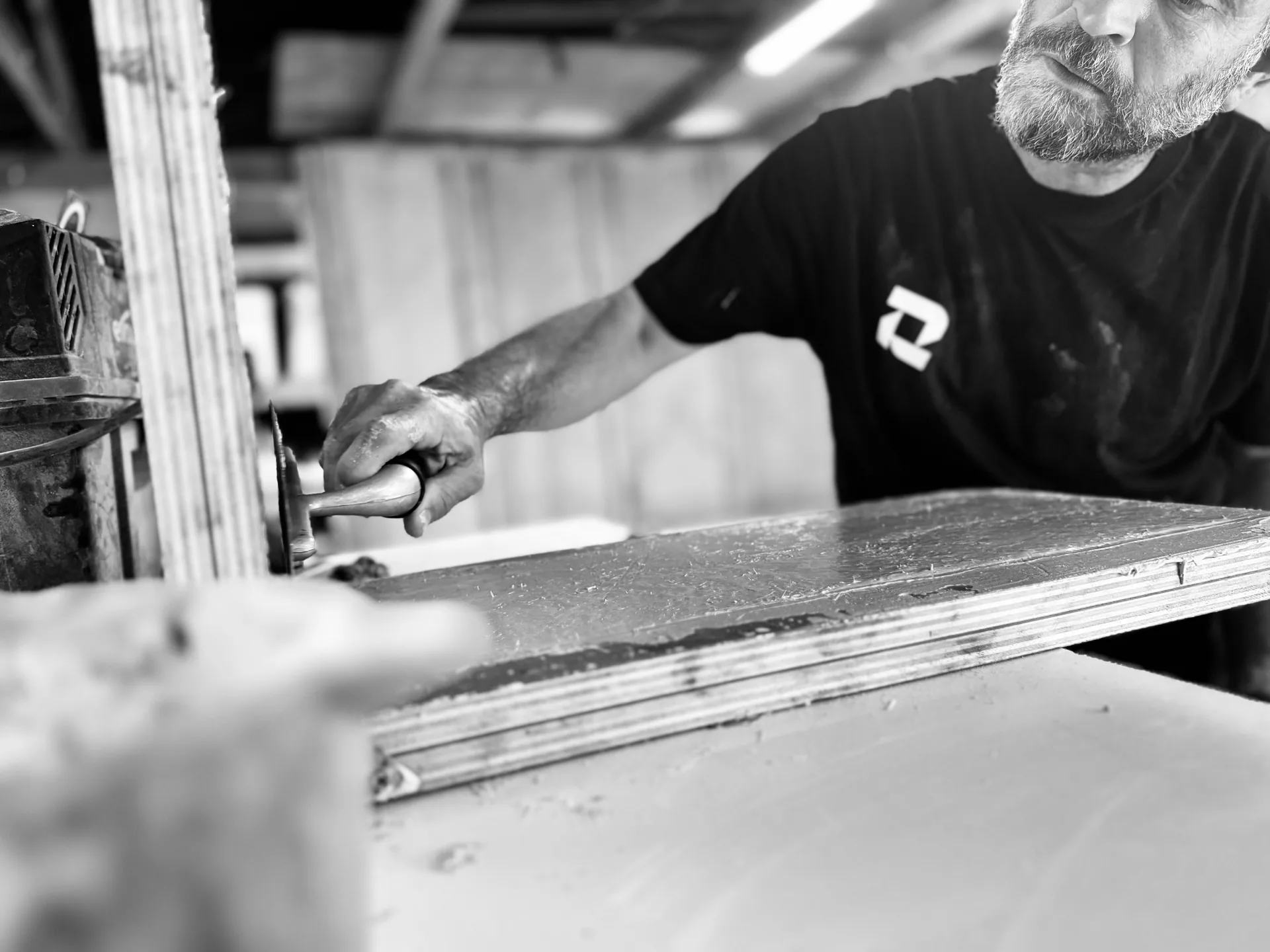
A cast concrete surface isn't finished afterwards — it's finished by the mould it was cast against. Whatever is on that mould face on casting day transfers straight into the concrete, which is why we spend as much care on the mould as on the mix.
Doesn't the concrete get finished afterwards?
Some pieces are ground or polished once they're out of the mould, and that's a separate process with its own rules. But the face that comes straight off the mould — most of what you see on a worktop, a cladding tile or a cast panel — is never touched again. What you're looking at is a direct print of the mould surface, not something smoothed over later.
What does the mould actually print onto the concrete?
Everything. Dust on the mould face becomes texture in the concrete. A fingerprint becomes texture. A scratch in the mould becomes a line in the finished piece. The film of release agent that lets the piece come out clean becomes part of the surface chemistry, for better or worse. None of this is metaphorical — it's a direct, physical transfer, which is why a mould has to be treated as a clean production surface, not a tool that can tolerate a bit of dust or a fingermark.
Why does mould preparation take so long, then?
Because every one of those transfers only goes one way. A board sanded to the wrong grit reads as texture on every single piece cast from it, not just the first one. Too little release agent and the mould can grip, tearing the surface on demould. Too much, and it can sit on the face as its own contamination, showing up as a patch, a pinhole cluster or a dull spot. Getting the mould right once means getting every casting off it right.
Why do sharp corners cause problems?
A sharp internal corner in a mould is hard to release cleanly, concentrates stress in the concrete right at the corner, and is one of the more common places for a small chip or a feathered edge to appear. A small radius at that internal corner softens the transition, releases cleanly, and is usually the difference between a corner that survives regular handling and one that doesn't — which is why it's treated as a structural detail as much as a visual one.
Can a mould defect be fixed after the piece is cast?
A small surface void can be filled with a matched material, but the fix isn't judged on the day it's made. A fresh repair reads darker and denser than the surrounding concrete simply because it's wetter — the same reason a whole cast face looks wrong before it's dry (see our post on why fresh concrete looks wrong wet). A repair only tells you the truth once it's reached the same dryness as everything around it.
If you're speccing a project where the finish has to be right first time, get in touch and we'll talk through what the mould needs to do before we ever mix the concrete.
See the colours and finishes for yourself.
Order free samples